
Search
Remove Ads
Advertisement
Search Results

Image
Buddhist Stele, Unified Silla Kingdom
A soapstone Buddhist stele from the Unified Silla Kingdom of Korea. From the Piamsa Temple. The scene depicts Buddha and disciples with apsaras looking on. Height: 40 cm, c. 673 CE. (National Museum of Korea...

Definition
Ancient India
India is a country in South Asia whose name comes from the Indus River. The name 'Bharata' is used as a designation for the country in their constitution referencing the ancient mythological emperor, Bharata, whose story is told...

Image
Art Nouveau Portuguese Ceramic Tile
The Art Nouveau period (c. 1890-1910 CE) saw the facades of Portuguese houses and buildings decorated with the flowing, curved lines of flowers, plants, vines, leaves, insects and animals that were typical of the...

Definition
Ajanta
Approximately 67 miles (107 km) to the north of Aurangabad in the Indhyadri range of Western Ghats lie the caves of Ajanta. The 30 caves, famous for their early Buddhist temple architecture and many delicately drawn murals, are located...

Article
The Temple of the Emerald Buddha
A small carved figurine sits high on a grand multi-tiered pedestal in a magnificent wat (temple) in Bangkok, Thailand. It has been sitting there since 1784 CE and was originally thought to be made of emerald. Hundreds...

Article
Ten Great Stupas from Around the World
A stupa is a reliquary containing the remains (relics) of an individual associated with great spiritual power and insight, most often (since the 3rd century BCE) with the Buddha (l. c. 563 - c. 483 BCE). The...
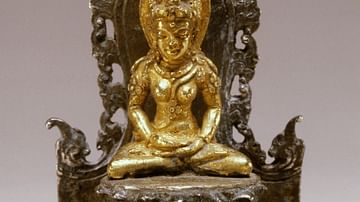
Image
The Buddhist Goddess Tara
The Buddist goddess Tara, gold and silver figure from Java, 9th century.
The Walters Art Museum, Baltimore, Maryland.

Article
The Dates of the Buddha
The dates of the Buddha, Siddhartha Gautama, have been a concern of, primarily, Western scholars for well over 100 years now owing to the particularly Western need for precise dating of historical persons and events. The...

Definition
Saichō
Saichō, also known as Dengyo Daishi (767-822 CE), was a monk and scholar who founded the Buddhist Tendai Sect in Japan. Based on the teachings of the Chinese Tiantai Sect, Saichō's simplified and inclusive version of Buddhism grew in...

Definition
Tibetan Book of the Dead
The Tibetan Book of the Dead is the English translation of the Tibetan texts known as bar-do thos-grol (Bardo Thodol) – “Liberation Through Hearing During the Intermediate State” – and serves as a guide for the soul of...
