
Search
Remove Ads
Advertisement
Search Results

Interview
Interview: Pre-Raphaelites: Modern Renaissance
Pre-Raphaelites: Modern Renaissance marks the first multidisciplinary exhibition in Italy to examine the profound impact of Italian Renaissance art on the Pre-Raphaelite movement, which flourished in Victorian...

Article
A. H. Foote's Account of the Battle of Fort Henry - Letter to His Wife on the Day of Victory
Union Flag Officer Andrew H. Foote (1806-1863) came to national attention during the American Civil War following his naval victory over Confederate land forces at the...

Article
Battle of Hampton Roads - Clash of the Ironclads
The Battle of Hampton Roads (8-9 March 1862), also known as the Battle of the Monitor and the Merrimack, Battle of Ironclads, or Clash of the Ironclads, was a naval engagement at the roadstead of Hampton...

Article
Chola Art & Architecture
Like many great civilisations, the origins of the Chola, a Tamil Hindu dynasty in southern India, are shrouded in the temporal mists of uncertainty and obscurity. It is however known that they were influential from at least...
Image
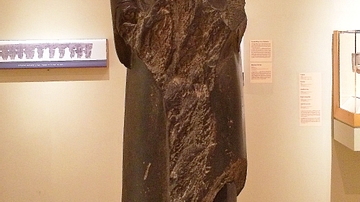
Statue of the Egypto-Persian Ptahhotep
This statue of Ptahhotep (who was the Overseer of the Treasury) is shown in a Persian costume that Egyptian officials adopted when Egypt was under Persian control. The jacket with flaring sleeves, over which...
Image
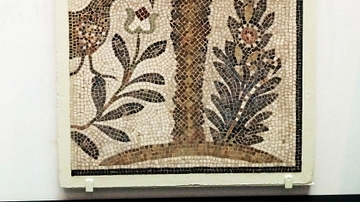
Jewish Mosaic of a Date Palm
This mosaic was once part of the mosaic found in an ancient synagogue in what's present-day Tunisia. This specimen dates from c. 550 CE and is made of stone and mortar. The date palm likely symbolized the Tree of Knowledge...
Image
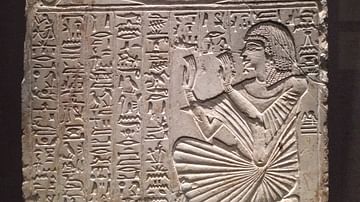
Ancient Egyptian Stela of Inherkhau
This funerary relief originally adorned the tomb in Egyptian Thebes of Inherkhau, a high official at the court of Ramesses III. It dates from 1184-1153 BCE or later, and it is made of limestone. Inherkhau kneels...

Image
Queen Ankhnes-meryre II & Pharaoh Pepi II
This alabaster statue of Pharaoh Pepi II (2284 - c. 2216 BCE) and his mother, is one of the more famous representations of the two because the statue technically has two “front” sides. By placing Pepi II and...
Image
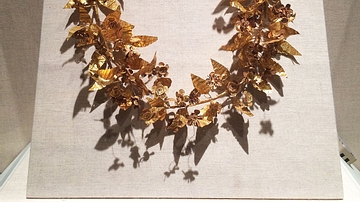
Ptolemaic Gold Wreath
Wreaths like this one formed to resemble flowers and leaves were used to crown athletic victors throughout the ancient Greek world. The Egyptian-born Greek writer Athenaeus of Nitocric (c. late 2nd-3rd century CE) tells of...

Image
Floral Frieze from Ancient Egypt
Although the use of glazed tiles and colored paste inlays is known from as early as the Old Kingdom, the apogee of their use came during the New Kingdom. An almost identical frieze of lotuses, other flowers, and grape...
