
Search
Did you mean: Odin?
Remove Ads
Advertisement
Search Results

Definition
Caesarea Maritima
Caesarea Maritima was a city built over 2,000 years ago (c. 22-10 BCE) on the coast of the Eastern Mediterranean. With Roman engineering and largesse, Herod the Great (r. 37-4 BCE) accomplished this feat by constructing a whole metropolis...

Definition
Wheel of the Year
The Wheel of the Year is a symbol of the eight Sabbats (religious festivals) of Neo-Paganism and the Wicca movement which includes four solar festivals - Winter Solstice, Spring Equinox, Summer Solstice, Fall Equinox - and four seasonal festivals...

Definition
Banastre Tarleton
Banastre Tarleton (1754-1833) was a British military officer and politician, most famous for his role in the southern campaigns of the American Revolutionary War (1775-1783). In command of an elite unit of Loyalists called the British Legion...

Image
Boxers Fresco, Akrotiri, Thera
The Boxers Fresco from Bronze Age Akrotiri on the island of Thera (Santorini), c. 1700 BCE. (National Archaeological Museum, Athens)
Image
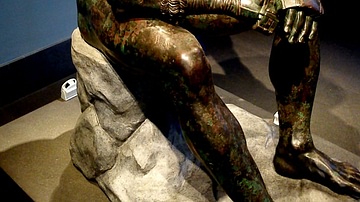
Boxer of Quirinal
The bronze Boxer of Quirinal, also known as the Terme Boxer, is a Hellenistic Greek sculpture dated around 330 BCE of a sitting boxer with Caestus, a type of leather hand-wrap, in the collection of the National Museum of Rome. It is one of...
Image
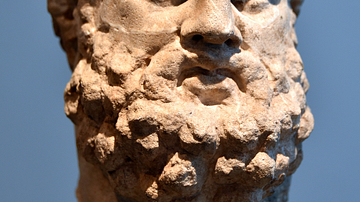
Herakles as Pugilist
This smaller than life-size head came from a statue that represented the Greek hero Herakles as a pugilist. Indications for this include the puffy ears that also appear in images of sportsmen. Herakles was their patron deity; the statue may...
Image
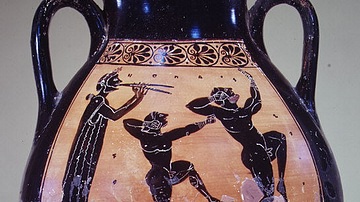
Terracotta Pelike Showing Flute Player and Boxers
This pelike, or wine jar, is a Greek piece, specifically Attic, displaying beautiful black-figure work customary of Athenian pottery. The scene shows a flute player and two boxers. It was dated to the Archaic period c. 510 BCE. The painter...

Article
Spartan Women
Spartan women had more rights and enjoyed greater autonomy than women in any other Greek city-state of the Classical Period (5th-4th centuries BCE). Women could inherit property, own land, make business transactions, and were better educated...

Article
Daily Life in Ancient Mesopotamia - Mirroring the Modern World
Daily life in ancient Mesopotamia cannot be described in the same way one would describe life in ancient Rome or Greece. Mesopotamia was never a single, unified civilization, not even under the Akkadian Empire of Sargon of Akkad (the Great...

Article
Agoge, the Spartan Education Program
The agoge was the ancient Spartan education program, which trained male youths in the art of war. The word means "raising" in the sense of raising livestock from youth toward a specific purpose. The program was first instituted by the lawgiver...
