
Search
Remove Ads
Advertisement
Search Results

Image
Demand for Tablets for the Libary of Ashurbanipal
Two almost similar letter tablets relaying the Assyrian king Ashurbanipal's orders to his employees to find local copies of particular compositions, which the royal library at Nineveh lacked. Sent from...

Image
Amel-Marduk's Poem & Prayer
"The wretched, weary person weeps..." The Crown Prince, son of Nebuchadnezzar II, wrote this anguished poem in prison. Once freed, he attributed his rescue to the god Marduk, by changing his name to Amel-Marduk (the Biblical...
Image
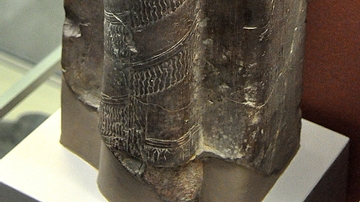
Stela of Ashurbanipal
The Assyrian king Ashurbanipal carries a large basket of earth on his head. From Borsippa (modern-day Birs Nimrud, Babel Governorate, Iraq), Mesopotamia. Neo-Assyrian period, circa 668-655 BCE. (The British Museum, London).

Definition
Mesopotamian Religion - Daily Life as a Form of Worship
Mesopotamian religion was central to the people's lives. Humans were created as co-laborers with their gods to hold off the forces of chaos and to keep the world running smoothly. As in ancient Egypt...

Definition
Ishtar Gate
The Ishtar Gate was constructed by the Babylonian King Nebuchadnezzar II circa 575 BCE. It was the eighth gate of the city of Babylon (in present-day Iraq) and was the main entrance into the city. The Ishtar Gate was part of Nebuchadnezzar's...

Definition
Hammurabi - Conquerer, King, and Law-Giver
Hammurabi (reign 1792-1750 BCE) was the sixth king of the Amorite First Dynasty of Babylon, best known for his famous law code, which served as the model for others, including the Mosaic Law of the Bible. He...

Definition
Ashurbanipal
Ashurbanipal (r. 668-627 BCE, also known as Assurbanipal) was the last of the great kings of Assyria. His name means "the god Ashur is creator of an heir" and he was the son of King Esarhaddon of the Neo-Assyrian Empire. In the Hebrew...

Article
Dogs & Their Collars in Ancient Mesopotamia - Man's Best Friend in the Ancient Near East
Among the many contributions to world culture credited to Mesopotamia is an object so familiar to people in the modern world that few pause to consider its origin: the dog...

Image
Map of Sumer
The area which formed Sumer started at the Persian Gulf and reached north to the 'neck' of Mesopotamia where the two rivers, the Tigris and the Euphrates meander much closer to each other. To the east loomed the Zagros Mountains...
Image
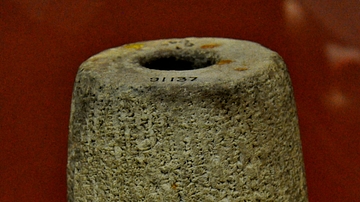
Terracotta Cylinder of Nebuchadnezzar II
This document records the king’s reconstructive work at the cities of Sippar, Ururk, Ur, Borsippa, Larsa, and Dilbat. It also commemorates the king’s repairing of the temple of Ninkarrak (a form of the healing...
