
Search
Remove Ads
Advertisement
Search Results
Image
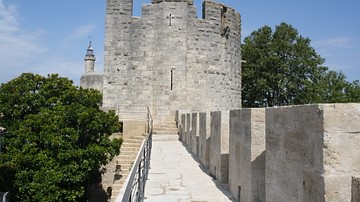
Aigues-Mortes Wall Walk
The wall walk (alure) and battlements at Aigues-Mortes, France. Originally 13th century CE.

Image
Wall Panel Depicting Bacchus and Silenus
This panel from a painted wall depicts the wine-god Bacchus and his companion, Silenus. Bacchus pours wine from a cup for the panther while Silenus plays the lyre. From a villa at Boscoreale, near Pompeii...

Image
Wall Reliefs, Kanchipuram
Sculptures on the sanctum wall of Airavatiswara Temple, Kanchipuram, India. 8th century CE.
Image
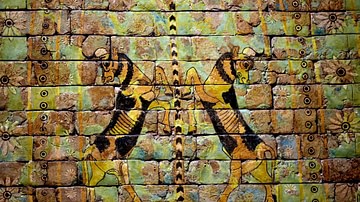
Glazed Wall Panel from Fort Shalmaneser
Detail of a large wall panel of vibrant glazed bricks once placed above the entrance to a vast room (T3) next to Shalmaneser III's throne room. The whole panel is composed of about 300 bricks and is 4 meters...

Image
Wall Decorations from the Tomb of Amenhotep II
These two fragments were part of wall decoration of the tomb of the Egyptian pharaoh Amenhotep II. They depict deities (with long curled beard) wearing the crown of Lower Egypt (left) and Upper Egypt (right...
Image
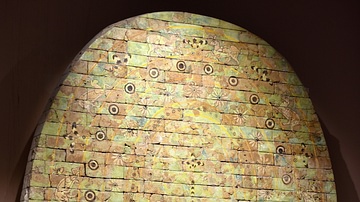
Glazed Wall Panel from Fort Shalmaneser
This large wall panel of vibrant glazed bricks was once placed above the entrance to a vast room (T3) next to Shalmaneser III's throne room at Fort Shalmaneser in Nimrud (in modern-day Nineveh Governorate, Iraq...

Image
Fragment of a Wall Decoration from the Tomb of Seti I
This polychrome hieroglyphic inscription includes parts of the "Litany of the Eyes of Horus". The hieroglyphic signs were painted with vibrant colors and carved in raised relief on a white background...

Image
Glazed Wall Tile from Nimrud
This glazed tile once decorated a wall in one of the Assyrian palaces at Nimrud (Kalhu). From Nimrud, in modern-day Iraq. Neo-Assyrian period, 911-609 BCE. (The British Museum, London).

Image
City Wall of Hattusa, Reconstruction
Modern reconstruction of a 65m long section of the city wall of Hattusa made of mud brick with defence towers built at intervals of 20-25 metres. The reconstructed part rests on top of the original Hittite foundations...

Image
Bronze Wall-Nail from Urartu
Known as siqqatu (in Akkadian), such nails are found in temples and palaces throughout the Middle East in this period. They were embedded in the walls of rooms and may have been used for wall-hangings. From Toprakkale...
