
Search
Remove Ads
Advertisement
Search Results

Definition
Jan van Eyck
Jan van Eyck (c. 1390-1441 CE) was a Netherlandish Renaissance painter who was famous in his own lifetime for his mastery of oil painting, colouring, naturalistic scenes, and eye for detail. Amongst his masterpieces are the 1432...

Definition
Hundred Days
The Hundred Days refers to the second reign of French Emperor Napoleon I, who unexpectedly returned from exile to reclaim the French throne. It encompasses Napoleon's triumphant return to Paris on 20 March 1815, his climactic defeat...

Definition
Battle of Valmy
The Battle of Valmy was a stunning French victory over a Prussian-led coalition army on 20 September 1792, during the French Revolutionary Wars (1792-1802). Although the battle was little more than a skirmish, it halted the coalition's...

Image
Map of the Schlieffen Plan v. the 1914 Reality
The Schlieffen Plan was Germany's strategic plan for a two-front war against France and Russia. Conceived in 1905 by Count Alfred von Schlieffen, Chief of the German General Staff, it aimed to achieve a...
Image
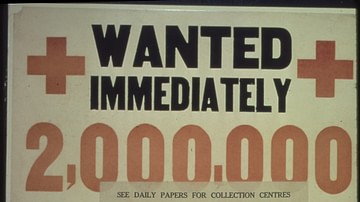
CRB Poster
Wanted Immediately. 2,000,000 Garments for destitute Men, Women, and children in occupied Northern France and Belgium. Poster advertising for contributions to the Commission for the Relief of Belgium, during the First World War (1914-1918...

Article
Trial and Execution of Marie Antoinette
The trial and execution of Marie Antoinette (1755-1793), formerly the queen of France, was among the opening events of the Reign of Terror during the French Revolution (1789-1799). Accused of a series of crimes...

Article
Assassination of Archduke Franz Ferdinand - The Road to WWI
The assassination of Archduke Franz Ferdinand (1863-1914) in the Balkans in the summer of 1914 set off a chain of events that led to the First World War (1914-18). For over a decade before, imperialistic...

Article
The Pre-WWI Alliance System - Triple Entente v. Triple Alliance
The alliance system in Europe was one of the causes of the First World War (1914-18), although it did not make war inevitable. In the first decade of the 20th century, the Triple Entente powers...

Article
How Germany Lost World War I
Germany started the First World War (1914-18) with the belief its armed forces could win a quick and decisive victory over France and then Russia. The reality turned out to be much more complicated as more countries...

Article
Battle of Waterloo
The Battle of Waterloo (18 June 1815) was the last major engagement of the Napoleonic Wars (1803-1815), fought by a French army under Emperor Napoleon I (r. 1804-1814; 1815) against two armies of the Seventh Coalition. Waterloo...
