
Search
Remove Ads
Advertisement
Search Results

Article
Social, Political & Economic Landscapes in Kautilya's Arthashastra
The Arthashastra (or Arthaśāstra) is one of the oldest surviving treatises on statecraft. There is considerable debate about the dating and authorship of the text; it underwent compilation...

Definition
Sleipnir
Sleipnir is the eight-legged horse ridden primarily by the god Odin in Norse mythology. He is the son of the god Loki (in the form of a mare) and the stallion Svadilfari who belonged to the jötunn that built the walls of Asgard. In...
Definition
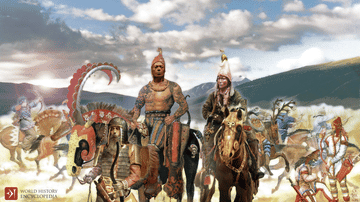
Scythians
The Scythians were a nomadic people whose culture flourished between the 7th and 3rd century BCE in a territory ranging from Thrace in the west, across the steppe of Central Asia, to the Altai Mountains of Mongolia in the east. This...

Article
Gilgamesh and the Bull of Heaven - Backstory to The Descent of Inanna
Gilgamesh and the Bull of Heaven is a Sumerian poem relating the event, now famous from the Epic of Gilgamesh, in which the goddess Inanna/Ishtar sends the celestial bull to attack Gilgamesh...

Image
Helmet from The Battle of The Aegates Islands
An iron helmet from the Battle of the Aegates Islands. 241 BCE. Soprintendenza del Mare, (National Maritime Museum, Sydney Australia)
Image
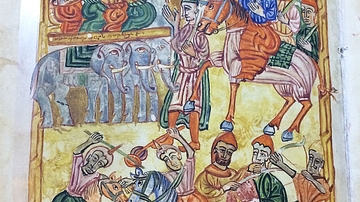
Persian & Armenian Battle Scene
Although this manuscript edition of the "History of Vardan and the Armenian War" was finished in 1569 CE, this illustration shows a battle between the Armenians and the Persians in the 5th century CE. Take special...

Image
Urartian Advancing into Battle and Disposal of Prisoners
The upper register shows Urartians advancing into battle (against the Assyrians) from mountains while the lower register shows handing over of prisoners to an Assyrian officer from the camp. Shalmaneser...
Article
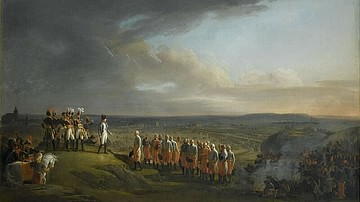
Ulm Campaign
The Ulm Campaign (25 September to 20 October 1805) was a military operation during the War of the Third Coalition (1805-1806). Through a series of maneuvers, the 210,000 men of the French Grande Armée, led by Emperor Napoleon I...

Definition
Harsha
Emperor Harshavardhana, better known as Harsha, lived from 590 to 647 CE and was the last ruler of the Vardhana Empire, the last great empire in ancient India before the Islamic Invasion. He ruled from 606 CE to 647 CE. After Harshavardhana's...

Definition
Geoffrey Chaucer
Geoffrey Chaucer (l. c. 1343-1400 CE) was a medieval English poet, writer, and philosopher best known for his work The Canterbury Tales, a masterpiece of world literature. The Canterbury Tales is a work of poetry featuring a group...
