
Search
Remove Ads
Advertisement
Search Results

Article
Top 10 Roman Sites in Bulgaria
Roman Bulgaria occupied an important position in the heart of the Balkans, between the Black Sea, the Aegean, and Asia Minor. In the north, the Danube River formed a heavily defended military frontier, lined with auxiliary...
Article
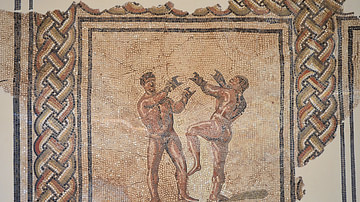
Boxing in the Roman Empire
Boxing is one of the oldest sports in the world that is still practiced today. Included in the original athletic contests of the Olympic Games, pugilism or boxing was well known and loved by the ancient Greeks and Romans...

Article
Exploring Roman Morocco
Morocco, then known as Mauretania, was annexed by the Roman Empire in 40 CE. The Romans in Morocco left a vast legacy with archaeological sites that dot the country's northern landscape, especially Volubilis, with its vestiges...

Article
The Arch of Septimius Severus, Rome
The Arch of Septimius Severus, erected in 203 CE, stands in Rome and commemorates the Roman victories over the Parthians in the final decade of the 2nd century CE. The triple triumphal arch was one of the most...

Definition
Ostia
Ostia (or Ostia Antica) lies 15 km from the city of Rome for which it served as the city's principal port and harbour throughout antiquity. The name derives from 'os' or 'ostium' which means 'mouth' and refers to the city's location at...

Definition
Cassius Dio
Cassius Dio (c. 164 - c. 229/235 CE) was a Roman politician and historian. Although he held a number of political offices with distinction, he is best known for his 80-volume Roman History. The work took 22 years to complete, was...
Article
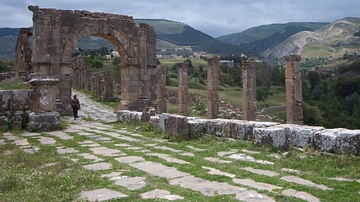
The Heritage of Cuicul
There are few places on earth where we can say that these stones, on which we are standing, are the same stones where feet rested centuries before. These places are important. We walk in the Roman Forum, we explore the...

Definition
Leptis Magna
Leptis Magna (aka Lepcis Magna), located in western Libya, North Africa, was a Phoenician city founded by Tyre in the 7th century BCE. Continuing to be a major city in the Roman period, it was the birthplace of Emperor Septimius...

Article
A Roman Trail in the Moselle Valley
The Moselle Valley is Germany's oldest winegrowing region. The Romans brought viticulture to this area and planted vines along the Moselle River 2000 years ago. After settling the region c. 50 BCE and establishing...

Article
Museums in the Ancient Mediterranean
Museums have been around much longer than one might think, but in the ancient world, they were principally institutions of research and learning rather than places to display artworks and artefacts, even if they...
