
Search
Remove Ads
Advertisement

 This answer was generated by
 Search Results

Image
Routes of the Barbarian Invaders
Routes of the Barbarian invaders into the Roman Empire during the Migration Age.
Image
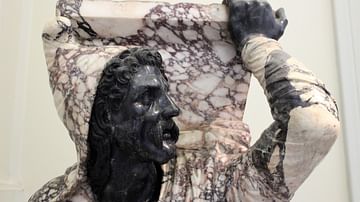
Detail of the Kneeling Barbarian
Detail of the "Kneeling Barbarian", also known as the "Farnese Barbarian". The use of coloured marbles allowed for a polychromatic sculpture without the use of paint or other pigments. Roman sculpture. c. 98-117 CE...
Image
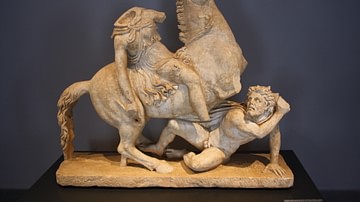
Amazon and Barbarian
Roman sculpture in pentellic marble. An amazon rider is about to deal the fatal blow to a barbarian. This marble sculpture is influenced by the 2nd century BCE Pergamene school of sculpture and itself dates from the mid-2nd...

Video
MILITARY HISTORY : Roman and Barbarian Weapons
Uploaded by MILITARY HISTORY 2015. A look at the Military History of the Romans and Barbarians Weapons. This show demonstrates the technologies and tactics used by conquering armies over the centuries...

Definition
Slavs
The term "Slavs" designates an ethnic group of people who share a long-term cultural continuity and who speak a set of related languages known as the Slavic languages (all of which belong to the Indo-European language family). Little...

Article
Continuity and Change after the Fall of the Roman Empire
The cataclysmic end of the Roman Empire in the West has tended to mask the underlying features of continuity. The map of Europe in the year 500 would have been unrecognizable to anyone living a...

Definition
Huns
The Huns were a nomadic tribe prominent in the 4th and 5th century whose origin is unknown but, most likely, they came from "somewhere between the eastern edge of the Altai Mountains and the Caspian Sea, roughly modern Kazakhstan" (Kelly...

Definition
Cimbri
The Cimbri were a tribe who lived in northern Jutland during the Roman era. Their ethnicity is enigmatic; scholars generally believe that the Cimbri were Germans, though others maintain that they were Celts. The late 2nd-century BCE migration...

Definition
Athanaric
Athanaric (died c. 381 CE) was a king of the Thervingi Goths (better known as the Visigoths) and, according to some sources, the first and greatest king. He was of the noble Balts family of the Thervingi tribe and a relative of the...

Image
Map of the Migration Period in Europe in the 4th-5th Century
The Migration Period in Europe (c. 4th–6th centuries CE) marks a prolonged era of movement, conflict, and political transformation rather than a single moment of collapse. Following the death...
