
Search
Did you mean: The Dagda?
Remove Ads
Advertisement
Search Results

Image
Babylonian Statue of Enki
A statue of Ea, the Akkadian god of water (related to the Sumerian god Enki). Ea is enthroned and holds a cup in his left hand, the right hand has been lost to time. He is accompanied by two creatures (half human and half...

Image
Bust of a Priest from Uruk
Grey alabaster statue of a male priest, found inside a pottery vessel in the ancient city of Uruk by a German archaeological team from the German Oriental Society in 1929-1930. Probably, it was buried after it got broken...

Image
Stele of Lion-Hunt from Uruk
Stele of a lion-hunt from Uruk, the oldest narrative Mesopotamian sculpture (in relief) and the first documented evidence of lion-hunting in Mesopotamia. It depicts two men hunting lions using a spear and arrows. One...

Image
Enlil
Baked clay statue of the Mesopotamian god Enlil, from the Scribal Quarter at Nippur, Iraq, 1800-1600 BCE.
Iraq Museum, Baghdad.
Image
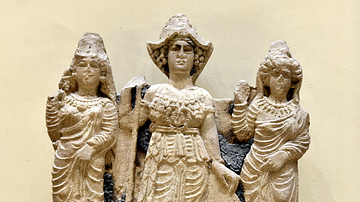
Relief of Al-Lat from Hatra
This carved scene in relief depicts 3 women above a standing and roaring lion. In the middle Al-Lat (also Allat, Allatu, and Alilat) wears a wonderful military attire and head cap (similar to Athena). Her right arm holds...
Image
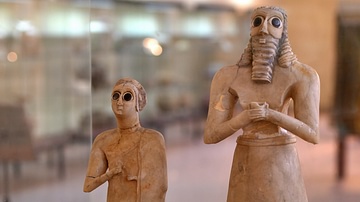
Sumerian Worshipers from Tell Asmar at the Iraq Museum
Amongst the most famous statues from Tell Asmar are these two standing male and female ones, which were made of veined gypsum. They have a wide-eyed gaze and hold a cup with their hands. The man...
Image
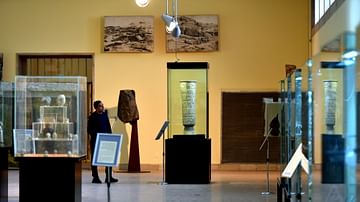
The Warka Vase at the Iraq Museum
A young man stands before and skims the votive Vase of Warka, one of the priceless objects in the Iraq Museum and represents one of the earliest surviving narrative art. The man was included in the image for comparison...
![Warka Vase [Bottom Register]](https://www.worldhistory.org/img/c/p/360x202/10536.jpg?v=1599153304)
Image
Warka Vase [Bottom Register]
The votive or sacred Warka Vase is decorated with three horizontal registers and shows signs of repair in antiquity. The bottom register of the Warka Vase is composed of two horizontal parts. The lower portion depicts...
Image
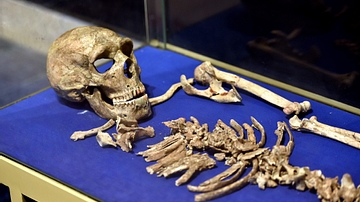
Shanidar 1 at the Iraq Museum
The skeletal remains of a Neanderthal corpse, which was found inside the Paleolithic cave of Shanidar, Erbil Governorate, Iraqi Kurdistan. If you zoom in the image on the right clavicular bone, someone wrote, using...
![Detail of Warka Vase [Top Register]](https://www.worldhistory.org/img/c/p/360x202/10595.jpg?v=1599154203)
Image
Detail of Warka Vase [Top Register]
The votive or sacred Warka Vase is decorated with three horizontal registers and shows signs of repair in antiquity. The top register depicts a complete scene. Here, a male figure holds what appears to be a belly...
