
Search
Remove Ads
Advertisement
Search Results
Image
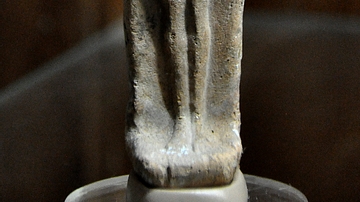
Erotic Old Babylonian Plaque
This terracotta plaque depicts a naked slim woman. She wears a necklace and what appears to be a strap (in three vertical layers) above the pelvis, with one of its ends hanging down on the right thigh. The plaque might have been used for...

Image
Babylonian Palace Scene
Artist's impression of a scene in a Babylonian palace. The illustration takes inspiration from the Ishtar Gate as well as the Hanging Gardens of Babylon, one of the Seven Wonders of the Ancient World. Created by Amplitude Studios for the...

Image
Terracotta Cylinder of the Babylonian King Nabopolassar
This document records the king’s reconstructive work on the wall of the city of Babylon. From Babylon (modern Babel governorate), neo-Babylonian era, 625-605 BCE, Mesopotamia, Iraq. (The British Museum, London).

Image
Clay Mask from the Old Babylonian Era
A clay mask depicting a face with acting expressions. Mesopotamian art usually portrays human faces in a poker-like configuration. This one has 3 small holes at the upper part which might have been used to attach it to a necklace with the...
Image
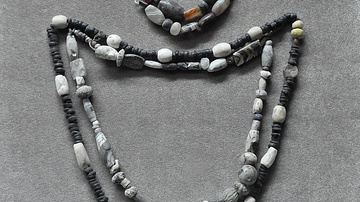
Necklaces from the Old Babylonian period
These 3 necklaces were founds inside graves. From Mesopotamia, modern-day Iraq. Old-Babylonian period, 2000-1500 BCE. The Sulaimaniya Museum, Iraq.

Definition
Cyrus the Great
Cyrus II (d. 530 BCE), also known as Cyrus the Great, was the fourth king of Anshan and the first king of the Achaemenid Empire. Cyrus led several military campaigns against the most powerful kingdoms of the time, including Media, Lydia...

Image
Bronze Figurine with Babylonian Cuneiform Inscription from Western Iran
Bronze figurine with Babylonian cuneiform inscription found in Luristan Province, c. 1000-900 BCE (Iron Age II), National Museum of Iran, Tehran, inv. no. 1408. Photo by Neda Tehrani (Baloot Noghrei) The cultural influence of Mesopotamia...
Definition
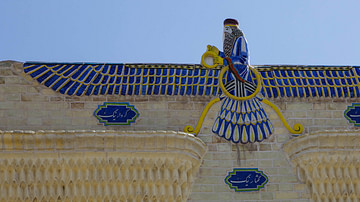
Zarathustra
Zarathustra (also given as Zoroaster, Zartosht, Zarathustra Spitama, l. c. 1500-1000 BCE) was the Persian priest-turned-prophet who founded the religion of Zoroastrianism (also given as Mazdayasna “devotion to Mazda”), the first monotheistic...

Definition
Mesopotamia - The Beginning of Beginnings
Mesopotamia (from the Greek, meaning "between two rivers") was an ancient region located in the Near East (Middle East) bounded in the northeast by the Zagros Mountains and in the southeast by the Arabian Plateau, corresponding to modern-day...

Video
The Babylonian Map of the World with Irving Finkel | Curator's Corner S9 Ep5
Fancy getting your hands on your very own Map of the World tablet replica? You can buy one here: https://www.britishmuseumshoponline.org/babylonian-map-of-the-world-tablet-replica.html?utm_source=yt&utm_medium=youtube&utm_campaign=map_world...
