
Search
Remove Ads
Advertisement
Search Results
Article
Daily Life in Colonial America
Life in Colonial America was difficult and often short but the colonists made the best of their situation in the hopes of a better life for themselves and their families. The early English colonists, used to purchasing...

Article
Women Scientists in the Scientific Revolution
Women scientists during the Scientific Revolution (1500-1700) were few in number because male-dominated educational institutions, as well as scientific societies and academies, barred women entry, meaning...
Article
How to Read a Maya Glyph
For over three centuries, the ancient Maya flourished in Mesoamerica. They built giant stone pyramids surrounded by dense jungle, used a calendrical system that made many believe that 2012 would be the end of the world...

Article
The Reforms of Peter the Great
Peter I of Russia (Peter the Great, l. 1672-1725) was the Tsar of Russia from 1682 to 1721 and the Emperor of Russia from 1721-1725. The lasting impression of Peter's long reign is the significant changes he brought...
Image
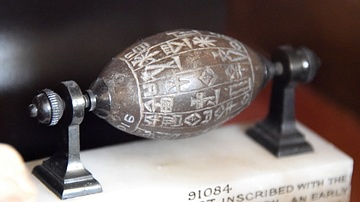
Macehead with the Name of Anum-mutabil
This oval stone mace-head was inscribed with the name of Anum-mutabil (formerly read as Ilum-muttabbil), governor of the Babylonian city Dur-ilu. The cuneiform inscription reads "Ilum-muttabbil, mighty man, favorite...

Collection
Kingdoms & Empires of Ancient Mesopotamia
The region of ancient Mesopotamia was home to several key kingdoms and empires that left a lasting impact on the region and influenced future civilizations. One of the earliest empires was the Akkadian Empire...
Image
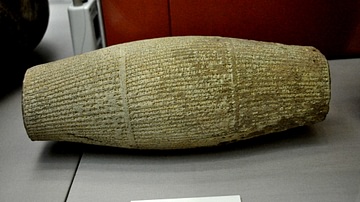
Terracotta Clay Cylinder of King Nebuchadnezzar II
The three columns of cuneiform inscriptions on this cylinder mention the building and reconstruction of various shrines, quays, gates, and processional boats by king Nebuchadnezzar II at Babylon for...

Image
A Pair of Lions from Tell Harmal at the Iraq Museum
Two terracotta lions found at the entrance to the Dagan Temple at Tell Harmal (ancient Shaduppum), in the eastern outskirt of Baghdad, Old Babylonian period, c. 1800 BCE. The temple was a typical Old-Babylonian...
Image
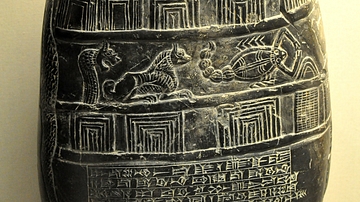
Boundary Stone from Mesopotamia
This boundary stone, or kudurru, records a gift of land made by Eanna-shum-iddina, governor of the Sea-Land in Southern Babylonia. The receiver's name is Gula-Eresh. The text ends with a series of curses on anyone...

Image
Map of the Median Hegemony, c. 600 BCE - Power, Influence & Transition in Western Asia after Assyria
The Median hegemony (late 7th-early 6th century BCE) emerged in the aftermath of the Bronze Age Collapse (c. 1200-1150 BCE) and, more directly, the disintegration...
