
Search
Remove Ads
Advertisement
Search Results

Article
The Athenian Calendar
The term "Athenian Calendar" (also called the "Attic Calendar") has become somewhat of a misnomer, since Ancient Athenians never really used just one method to reckon the passage of time. Athenians, especially from the 3rd...

Article
Dialogue of Pessimism - Meaning of Life or Satire?
The Dialogue of Pessimism (circa 1000 BCE) is a Babylonian poem featuring a master and his slave in ten exchanges during which the master proposes an action, and the slave gives reasons for and against...

Article
Sammu-Ramat and Semiramis: The Inspiration and the Myth
Sammu-Ramat (r. 811-806 BCE) was the queen regent of the Assyrian Empire who held the throne for her young son Adad Nirari III (r. 811-783 BCE) until he reached maturity. She is also known as Shammuramat...

Article
Mesopotamian Education - Creating the First Written Works in History
Mesopotamian education was invented by the Sumerians following the creation of writing circa 3600/3500 BCE. The earliest schools were attached to temples, but later schools were established...

Article
The Queen of the Night - The Mysterious Burney Relief
The Queen of the Night (also known as the "Burney Relief") is a high-relief terracotta plaque of baked clay, 19.4 inches (49.5 cm) high, 14.5 inches (37 cm) wide, with a thickness of 1.8 inches (4.8...

Article
Diodorus Siculus' Account of the Life of Semiramis
Semiramis is the semi-divine Warrior-Queen of Assyria, whose reign is most clearly documented by the Greek historian Diodorus Siculus (l. 90-30 BCE) in his great work Bibliotheca Historica ("Historical...

Article
Biblical Apocalypse
Apocalypse (Greek: apokalypsis, an "unveiling of secrets") is not an event, but a text that contains prophesies concerning God’s future intervention, and apocalypticism is a reference for attitudes and worldviews in biblical...
Article
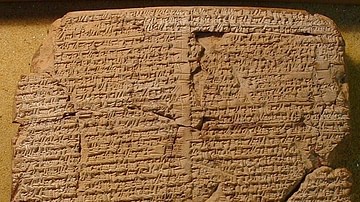
Ancient Mesopotamian Ghost Spell - Keeping the Dead Where They Belong
Medicine in ancient Mesopotamia was based on the belief that illness was caused by supernatural agencies and, although medicines were given and injuries treated, magical spells and incantations...

Image
Market Scene
This is an artist's impression of how an ancient Greek or Roman agora or forum (market) may have looked like.

Image
Mesopotamian Ceramic Objects Used in Magical Liturgy
Three rounded ceramic objects with saw-teeth-like margins. They have small holes on both the ventral and the dorsal aspects. Upon moving them, a sound comes out as if there is a small object inside...
