
Search
Remove Ads
Advertisement
Search Results

Definition
Kosrau I
Kosrau I (r. 531-579 CE) was the greatest king of the Sassanian Empire (224-651 CE) in virtually every aspect of his reign. He reformed the military, the Persian government, expanded his territories, engaged in large-scale building...

Article
Weapons of the Conquistadors
The Iberian conquistadors ("conquerors") were the first military men to explore, attack, and conquer territories in the Americas and Asia that would then become a part of the Spanish or Portuguese Empire. Indigenous...

Article
Death and the Afterlife in Ancient Persia
A vision of the afterlife is articulated by every culture, ancient or modern, in an effort to answer the question of what happens after death. Ancient Persia had the same interest in this as any culture of...

Definition
Byzantine Empire
The Byzantine Empire existed from 330 to 1453. It is often called the Eastern Roman Empire or simply Byzantium. The Byzantine capital was founded at Constantinople by Constantine I (r. 306-337). The Byzantine Empire varied in...

Definition
Urartu Art
The art produced by the Urartu civilization, which flourished in ancient Armenia, eastern Turkey, and northwestern Iran from the 9th to 6th century BCE, is best seen in bronze figurines of deities, bronze cauldrons with animal and...

Definition
Saxon Wars
The Saxon Wars (772-804) were a series of conflicts between the Franks under Charlemagne, who sought to conquer Saxony and convert the populace to Christianity, and the Saxons who resisted. The conflict lasted over 30 years through...

Definition
Cyclades
The Cyclades are a group of islands in the southern Aegean situated between the Greek mainland and Turkey. The name was coined in the Archaic period as the islands form an approximate circle (kyklos) around the central and most sacred...

Definition
The Vedas
The Vedas are the religious texts which inform the religion of Hinduism (also known as Sanatan Dharma meaning “Eternal Order” or “Eternal Path”). The term veda means “knowledge” in that they are thought to contain the fundamental knowledge...
Definition
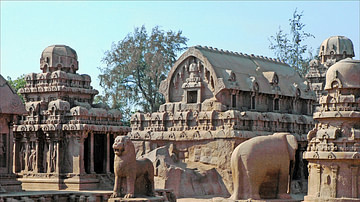
Mahabalipuram
Mahabalipuram or Mamallapuram is a historic city and UNESCO World Heritage site in Tamil Nadu, India. During the reign of the Pallava dynasty, between the 3rd century CE and 7th century CE, it became an important centre of art...

Definition
Macedon - Birthplace of Alexander the Great
Macedon was an ancient kingdom located in the north of the Greek peninsula first inhabited by the Mackednoi tribe whose identity was challenged by some southern Greeks but who, according to Herodotus (5:22...
