
Search
Did you mean: Chrocus?
Remove Ads
Advertisement
Search Results

Article
Azulejos: The Visual Art of Portugal
Glazed blue ceramic tiles or azulejos are everywhere in Portugal. They decorate the winding streets of the capital, Lisbon. They cover the walls of train stations, restaurants, bars, public murals, and fountains, churches, and altar fronts...

Article
Visiting the Ancient City of Babylon
We had a 4-day national holiday. Meaning what? No clinic and no hospital! I said to myself, “It's been a long time since I have visited Babylonia.” I drove my car for about 11 hours, continuously. Finally, I was there. I went to my uncle's...
Image
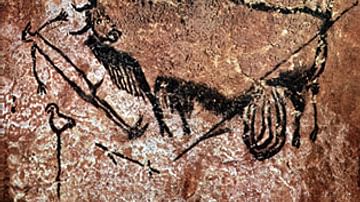
Wounded Bull, Man & Bird, Lascaux Cave
Cave art in the Lascaux Cave in the Dordogne region, southwestern France. Dated to the Upper Palaeolithic period. It depicts a wounded aurochs bull, a man and a bird.

Image
Great Gate of Ishtar
This is a reconstruction of the Great Gate of Ishtar that stood at the entrance to the ancient city of Babylon. The Babylonian King Nebuchadnezzar II (r. 605/604-562 BCE) ordered the gate to be constructed in c. 575 BCE and it features lions...

Image
Oldest Mural in Europe
This photo shows a reconstruction of the "Cult Wall" of Ludwigshafen, the oldest mural in Europe. The original painting was created around 3860 BCE, depicting hunting trophies of aurochs and bison, fine textiles, as well as a human torso...
Image
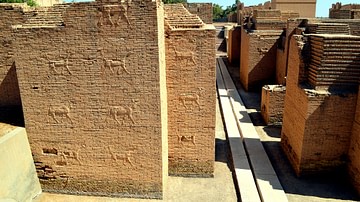
Part of the Processional Way at Babylon
This is part of the processional way (or street) at the ancient city of Babylon, in modern-day Iraq. The reliefs of aurochs (bulls) and mušḫuššus (dragons) are originals, as are the flanking walls. Neo-Babylonian period, reign of Nebuchadnezzar...

Video
The Ishtar Gate of Babylon at the Pergamon Museum, Berlin
This gate was built at the northern side of the city of Babylon by the king Nebuchadnezzar II in 575 BCE. It was the eighth gate into the city of Babylon, Mesopotamia (modern Babil Governorate, Iraq). The gate was built with glazed bricks...
