
Search
Remove Ads
Advertisement
Search Results

Article
Caesarea Maritima's Role in the Mediterranean Trade
Caesarea Maritima was located on the eastern coast of the Mediterranean Sea. Built from the ground up in 22-10 BCE by Rome's client king, Herod the Great (r. 37-4 BCE), its location in relation to ship traffic and proximity to historical...

Image
German Atlantic Wall Defences
A photograph taken in March 1944 showing a gun emplacement, part of Nazi Germany's Atlantic Wall defences along the coastline of occupied northern Europe. The defences were built in preparation for the Allied landings which came on D-Day...

Image
North Atlantic Convoy, 1941
A 1941 photograph taken from the battleship HMS King George V and showing ships of a North Atlantic convoy during the Second World War (1939-45). Convoys were essential to get vital supplies and weaponry from North America to Britain during...

Definition
Pirates in the Ancient Mediterranean
Piracy, defined as the act of attacking and robbing a ship or port by sea, had a long history in the ancient Mediterranean stretching from the time of the Egyptian pharaoh Akhenaten (r. 1353-1336 BCE) and throughout the Middle Ages (c. 476-1500...
Image
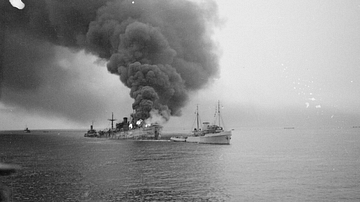
Battle of the Atlantic, 1943
A May 1943 showing a Dutch tugboat, the Zwarte Zee, towing a US freighter which is on fire after an attack by a German U-boat. The freighter was part of a convoy taking supplies from Marshall, Liberia to Freetown, Sierra Leone. (Imperial...

Article
Trade Unions in the British Industrial Revolution
Trade unions were formed in Britain during the Industrial Revolution (1760-1840) to protect workers from unnecessary risks using dangerous machines, unhealthy working conditions, and excessive hours of work. The trade union movement was vigorously...

Article
Eyes on the East: Chronicles of the Indian Ocean Spice Trade
As the 15th century ended, Europeans were still mostly in the dark about the Eastern world. Early travelers like Marco Polo had given the West tidbits of information, but these accounts were too highly colored and fragmentary to provide a...

Article
Trade in the Byzantine Empire
Trade and commerce were essential components of the success and expansion of the Byzantine Empire. Trade was carried out by ship over vast distances, although for safety, most sailing vessels were restricted to the better weather conditions...
Article
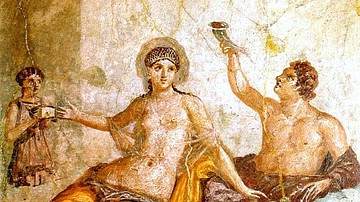
The Eastern Trade Network of Ancient Rome
The life of wealthy Romans was filled with exotic luxuries such as cinnamon, myrrh, pepper, or silk acquired through long-distance international trade. Goods from the Far East arrived in Rome through two corridors – the Red Sea and the Persian...

Article
Paul's Journeys and the Mediterranean Trade
Mediterranean trade increased exponentially at the turn of the first millennium. During Rome's zenith, goods of all sorts began to move in all directions. As a common traveler aboard merchant ships, Paul traveled within such a milieu. Tracing...
