
Search
Remove Ads
Advertisement
Search Results

Article
Trade in the Phoenician World
The Phoenicians, based on a narrow coastal strip of the Levant, put their excellent seafaring skills to good use and created a network of colonies and trade centres across the ancient Mediterranean. Their major trade routes were by sea to...

Image
Slave Trade
Execrable Human Traffick, or The Affectionate Slaves, oil on canvas by George Morland, c. 1788. Depicted here is a scene of a man being abducted by slavers on the coast of Africa as his family watches. From the 16th to the 19th century...

Definition
Harriet Jacobs
Harriet Jacobs (l. c. 1813-1897) was a former slave, abolitionist, and author of Incidents in the Life of a Slave Girl (1861), her autobiography, describing her life as a slave in North Carolina, her flight to freedom in the North, and her...

Article
The Portuguese Colonization of São Tomé and Principe
São Tomé and Principe are islands located in the Gulf of Guinea in West Africa. They were uninhabited before being colonised by the Portuguese from 1486. So involved were they with the slave trade, they became known as the Slave Islands where...

Article
The Gold Trade of Ancient & Medieval West Africa
West Africa was one of the world's greatest producers of gold in the Middle Ages. Trade in the metal went back to antiquity but when the camel caravans of the Sahara linked North Africa to the savannah interior, the trade really took off...

Article
Trade in the Roman World
Regional, inter-regional and international trade was a common feature of the Roman world. A mix of state control and a free market approach ensured goods produced in one location could be exported far and wide. Cereals, wine and olive oil...

Article
The Salt Trade of Ancient West Africa
Salt from the Sahara desert was one of the major trade goods of ancient West Africa where very little naturally occurring deposits of the mineral could be found. Transported via camel caravans and by boat along such rivers as the Niger and...
Article
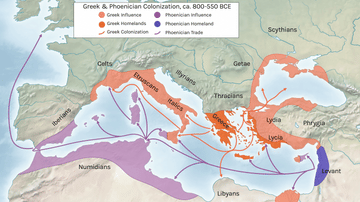
Trade in Ancient Greece
Trade was a fundamental aspect of the ancient Greek world and following territorial expansion, an increase in population movements, and innovations in transport, goods could be bought, sold, and exchanged in one part of the Mediterranean...

Image
German Atlantic Wall Defences
A photograph taken in March 1944 showing a gun emplacement, part of Nazi Germany's Atlantic Wall defences along the coastline of occupied northern Europe. The defences were built in preparation for the Allied landings which came on D-Day...

Image
North Atlantic Convoy, 1941
A 1941 photograph taken from the battleship HMS King George V and showing ships of a North Atlantic convoy during the Second World War (1939-45). Convoys were essential to get vital supplies and weaponry from North America to Britain during...
