
Search
Search Results
Definition
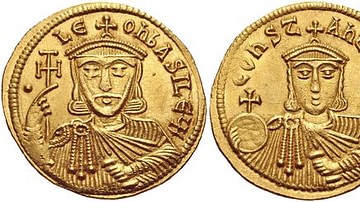
Leo V the Armenian
Leo the V the Armenian was emperor of the Byzantine Empire from 813 to 820 CE. He was of Armenian descent and the last ruler of the Isaurian dynasty which had been founded by Leo III (r. 717-741 CE). The emperor's reign, after early military...

Definition
Michael II
Michael II the Amorion, also known as Michael “the Stammerer”, was emperor of the Byzantine Empire between 820 and 829 CE. He founded the short-lived Amorion dynasty, named after his hometown in Phrygia, which would last until 867 CE. Surviving...

Definition
Year of the Four Emperors - When Four Men Battled For Control of the Roman Empire
The Year of the Four Emperors (69 CE) was a brief period of political upheaval and civil war in the Roman Empire. In the aftermath of the death of Emperor Nero, four men – Galba, Otho, Vitellius, and Vespasian – were recognized as emperor...
Article
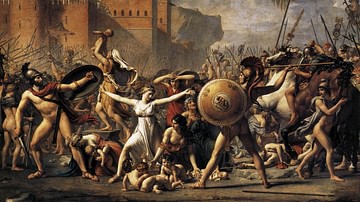
The Role of Women in the Roman World
The exact role and status of women in the Roman world, and indeed in most ancient societies, has often been obscured by the biases of both ancient male writers and 19-20th century CE male scholars, a situation only relatively recently redressed...

Article
The Propaganda of Octavian and Mark Antony's Civil War
Propaganda played an important role in Octavian (l. 63 BCE - 14 CE) and Mark Antony's (l. 83 – 30 BCE) civil war, and once victorious at the Battle of Actium (31 BCE), Octavian returned home to become the first Roman emperor. The decade preceding...

Article
The Siege of Acre, 1291 CE
The Siege of Acre in 1291 CE was the final fatal blow to Christian Crusader ambitions in the Holy Land. Acre had always been the most important Christian-held port in the Levant, but when it finally fell on 18 May 1291 CE to the armies of...

Article
The Great Palace of Constantinople
The Great Palace of Constantinople was the magnificent residence of Byzantine emperors and their court officials which included a golden throne room with wondrous mechanical devices, reception halls, chapels, treasury, and gardens. In use...
Article
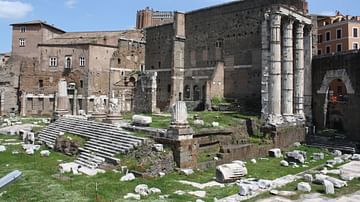
Temple of Mars Ultor, Rome
The Temple of Mars Ultor stands in the Forum of Augustus in Rome and was built to commemorate Augustus' victory in 42 BCE at the Battle of Philippi over the assassins of Julius Caesar. The building became the place where important military...

Article
Rome under the Julio-Claudian Dynasty
The Julio-Claudians were the first dynasty to rule the Roman Empire. After the death of the dictator-for-life Julius Caesar in 44 BCE, his adopted son Octavian - later to become known as Augustus (r. 27 BCE - 14 CE) - fought a civil war against...
Article
The Year of the Four Emperors & the Demise of Four Roman Legions
During the Year of the Four Emperors (69 CE), the fight between Vitellius and Vespasian would ultimately bring about the demise of four legions, the XV Primigenia, I Germanica, IIII Macedonica, and XVI Gallia. All four of these legions had...
