
Search
Search Results

Definition
Nitocris
Nitocris (2184-2181 BCE) is the Greek name for Nitiqret, the last monarch of the 6th Dynasty of Egypt which concluded the period of the Old Kingdom (c. 2613-2181 BCE). Nitocris is best known from the story told of her by Herodotus (484-425/413...

Definition
Decebalus
Decebalus (c. 87-106 CE) was the king of Dacia (roughly modern-day Romania and Moldova) who fought two wars with Rome under Trajan (in 101-102 CE and 105-106 CE) in defense of his kingdom. Trajan (r. 98-117 CE) was renewing a conflict between...

Definition
James I of Scotland
James I of Scotland ruled as king from 1406 to 1437. In 1406, the future king was captured by pirates and then imprisoned by Henry IV of England (r. 1399-1413), a confinement that lasted for 18 years. He succeeded his father Robert III of...

Collection
Genghis Khan & the Mongol Empire
Through the 13th and 14th century CE the Mongols forged the largest connected empire the world had ever seen and such figures as Genghis Khan and Kublai Khan were feared as the devil himself, their mounted warriors conquering for their leaders...

Image Gallery
Reconstructions of Asian Castles
This high-definition gallery presents digital reconstructions of six iconic Asian castles, from Afghanistan to Japan. Many of these castles have taken damage since then due to wars, political instability, and even deliberate cultural destruction...

Article
Saladin & the Unification of the Muslim Front: 1169-1187 CE
Saladin (c. 1137 – 1193 CE), the Muslim ruler who crushed the mighty Crusader army at the Horns of Hattin (1187 CE) and re-took Jerusalem after 88 years of Crusader control, was born in a world where the disunity of the Muslims had allowed...
Image
Reconstruction of Alamut Castle
Reconstruction of Alamut Castle in present-day Iran, as it may have appeared in 1090 CE when it was captured by Imam Hassan-i Sabbāh, of the Assassins (aka Nizari Ismailis). The castle was built c. 865 CE, although it was expanded and fortified...
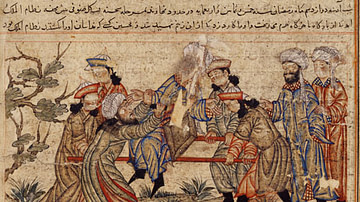
Image
The Assassination of Nizam al-Mulk
An agent of the Assassins (left, in white turban) fatally stabs Nizam al-Mulk, a Seljuk vizier, in 1092 CE.
14th-century CE manuscript
Topkapi Palace Museum, Cami Al Tebari TSMK, Inv. No. H. 1653, folio 360b
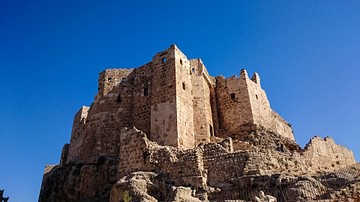
Image
Masyaf Castle, Syria
Masyaf castle, Orontes Valley, Syria, one-time castle of the Assassins (aka Nizari Ismailis) from c. 1141 CE to 1256 CE.

Image
Map of the Crusader States (Outremer), 1096-1291
The Crusader States, collectively known as Outremer (from Old French outre-mer, “overseas”), were a group of Latin Christian polities established in the eastern Mediterranean following the First Crusade (1096–1099). Emerging from the conquest...
