
Search
Remove Ads
Advertisement
Search Results
Definition
Vejovis
Vejovis (sometimes spelt Vediovis) was an obscure Roman deity. He is poorly attested in both written sources and archaeology, and his nature is debated by scholars. His name is related to Jove (Jupiter), and some authors described him...

Definition
Cassius Dio
Cassius Dio (c. 164 - c. 229/235 CE) was a Roman politician and historian. Although he held a number of political offices with distinction, he is best known for his 80-volume Roman History. The work took 22 years to complete, was...

Definition
Carthage
Carthage was a Phoenician city-state on the coast of North Africa (the site of modern-day Tunis) which, prior the conflict with Rome known as the Punic Wars (264-146 BCE), was the largest, most affluent, and powerful political entity...
Definition
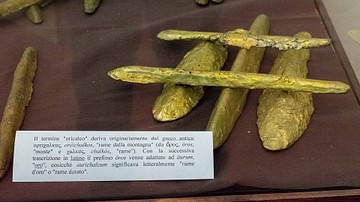
Orichalcum
Orichalcum ("mountain copper") or aurichalcum ("gold copper") was a metal used in coins during ancient times. Orichalcum was a golden-yellow coloured mixture consisting of both copper and zinc and referred to as brass. The Romans...

Definition
Gaius Marius
Gaius Marius (c. 157-86 BCE) was an accomplished military commander and politician who was acclaimed for saving Rome from the brink of collapse. Yet, unfortunately, his name has only survived in relative obscurity because his achievements...

Definition
Punic Wars
The Punic Wars were a series of conflicts fought between Carthage and Rome between 264 BCE and 146 BCE. The name Punic comes from the word Phoenician (Phoinix in the Greek, Poenus from Punicus in Latin) as applied to the citizens...
Definition
Plutarch
L. Mestrius Plutarchus, better known simply as Plutarch, was a Greek writer and philosopher who lived between c. 45-50 CE and c. 120-125 CE. A prodigious and hugely influential writer, he is now most famous for his biographical works...
Definition
Galba
Galba was Roman emperor from June 68 to January 69 CE. With the death of Emperor Nero on June 9, 68 CE, the Julio-Claudian dynasty officially ended, leaving the Roman Empire without a clear successor to the throne. With the assistance...

Definition
Sejanus
Lucius Aelius Seianus or Sejanus (20 BCE-31 CE) was the commander of the praetorian guard under the emperor Tiberius (14-37 CE). Coming from an obscure equestrian family, he managed to become one of the closest advisor of Tiberius, hoping...

Definition
New Testament
New Testament is the name for the second half of the Christian Bible, compiled from the 2nd century CE, after the separation of Christianity from Judaism. The Christian Bible retained books of the Jewish scriptures, the Old Testament...
