
Search
Did you mean: Artemis?
Remove Ads
Advertisement

 This answer was generated by
 Search Results

Definition
Artemisia I of Caria
Artemisia I of Caria (l. 480 BCE) was the queen of the Anatolian region of Caria (south of ancient Lydia, in modern-day Turkey). She is most famous for her role in the naval Battle of Salamis in 480 BCE in which she fought for the Persians...
Image
Artemisia of Caria
Artemisia I of Caria as depicted in the fictional Hollywood movie 300: Rise of an Empire, played by Eva Green. This depiction is a modern cinematic representation of the character and does not reflect the historical Artemisia. This...

Image
Statue of Artemisia
Marble statue of a woman from Mausoleum at Halicarnassus, also known as the Tomb of Mausolus. Identified as Artemisia, wife of Maussollos. From Mausoleum, the main sculptural deposit, north of the north wall of the Peribolus. Classical Greek...
Image
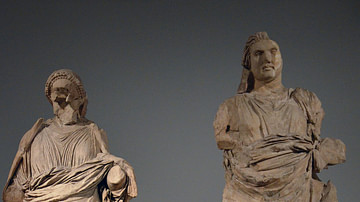
Colossal Statues of Mausolus and Artemisia II
Colossal statues of a man and a woman from the Mausoleum at Halicarnassus, traditionally identified as Mausolus and Artemisia II, around 350 BCE. (British Museum, London)

Definition
Halicarnassus
Halicarnassus (modern Bodrum, Turkey) was an ancient Ionian Greek city in the region of Caria, located on the coast of Anatolia. It is best known as the birthplace of Herodotus (l. c. 484-425/413 BCE), the 'Father of History', and as the...
Article
Twelve Great Women of Ancient Persia
Women in ancient Persia had more rights and greater freedom than any other ancient civilization including, according to some scholars, even ancient Egypt which is famous for its respect for the feminine principle in religion as well as daily...

Article
Ten Great Ancient Mesopotamian Women - Monarchs, Generals, and Scribes
The lives of women in ancient Mesopotamia were regulated by a patriarchal hierarchy, but within this social structure, there were many who distinguished themselves and some who were able to assume positions traditionally held by men. Women...

Definition
Xerxes I
Xerxes I (l. 519-465, r. 486-465 BCE), also known as Xerxes the Great, was the king of the Persian Achaemenid Empire. His official title was Shahanshah which, though usually translated as `emperor', actually means `king of kings'. He is identified...

Definition
The Seven Wonders
The Seven Wonders of the Ancient World were seven impressive structures famously listed by ancient writers including Philo of Byzantium, Antipater of Sidon, Diodorus Siculus, Herodotus, Strabo, and Callimachus of Cyrene, among others. The...

Definition
Mausoleum at Halicarnassus
The Mausoleum at Halicarnassus (Bodrum, Turkey), was a massive tomb built for Mausolus, the ruler of Caria, c. 350 BCE. The marble structure was so immense and decorated with such an array of striking sculptures that it made it onto the list...
