
Search
Remove Ads
Advertisement
Search Results
Article
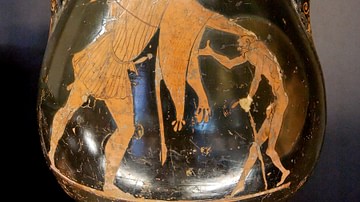
Growing Old in Ancient Greece & Rome
Although life expectancy was lower in ancient Greece and Rome, many people survived into old age. Those who reached old age tended to accumulate wealth and political power. However, the societies of the ancient Mediterranean were also often...

Article
Ten Noble and Notorious Women of Ancient Greece
Women in ancient Greece, outside of Sparta, had almost no rights and no political or legal power. Even so, some women broke through the social and cultural restrictions to make their mark on history. All of the women did so at great personal...

Article
Food & Agriculture in Ancient Greece
The prosperity of the majority of Greek city-states was based on agriculture and the ability to produce the necessary surplus which allowed some citizens to pursue other trades and pastimes and to create a quantity of exported goods so that...

Article
Sacred Cakes in Ancient Greece
Sacred cakes in ancient Greece were baked loaves, biscuits, pastries, and sponges sweetened with honey (meli) and prepared as unburnt offerings to the gods and goddesses and other divine beings. Unburnt offerings were substitutes for or a...

Lesson Pack
Daily Life & Religion in Ancient Greece
We have prepared three lesson plans and two supplemental lesson plans including classroom activities, assignments, homework, and keys as well as: - Multiple choice quiz questions in an excel format. - Glossary of keywords and concepts...
Article
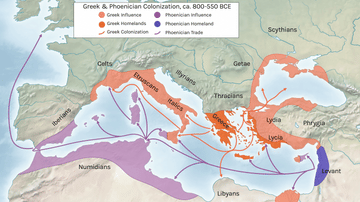
Trade in Ancient Greece
Trade was a fundamental aspect of the ancient Greek world and following territorial expansion, an increase in population movements, and innovations in transport, goods could be bought, sold, and exchanged in one part of the Mediterranean...

Image
Clay tablet from the Archaic Buildings of Ishtar Temple
This clay tablet lists the names of certain persons with their corresponding official designation. The Archaic buildings of the Ishtar Temple were in use from 2500-2000 BCE. From the Archaic temples (or buildings) of Ishtar at the city of...
Image
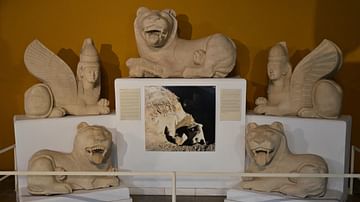
Cypro-Archaic Sculptures
Five unique Cypro-Archaic sculptures found in situ in the necropolis of Talmassos, one oversize lion, two lions of smaller dimensions and two sphinxes. 6th century BCE (Cypro-Archaic II period). Cyprus Museum, Nicosia.
Image
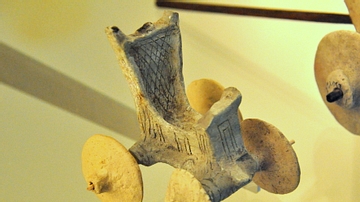
Votive Toy from the Archaic Buildings of the Ishtar Temple
This small terracotta toy in the shape of a wagon was a votive donation to the goddess Ishtar. The Archaic buildings of the Ishtar temple were in use from 2500-2000 BCE. From the Archaic temples (or buildings) of Ishtar at the city of Ashur...
Image
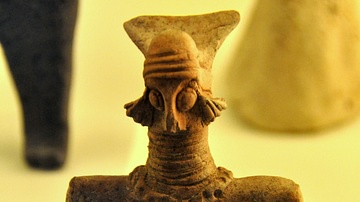
Votive Statuette from the Archaic Buildings of the Ishtar Temple
Only the upper half of this small female terracotta statuette has survived. The woman wears a hat and a necklace and covers her naked breasts with her hands. The Archaic buildings of the Ishtar Temple were in use from 2500-2000 BCE. From...
