
Search
Remove Ads
Advertisement
Search Results
Image
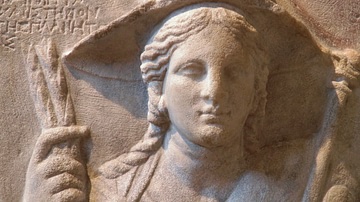
Isis from Dion, Greece
Votive relief with a depiction of Isis, from the facade of the main temple of the Sanctuary of Isis in Dion (Greece). Second half of 3rd–early 2nd century BCE. Isis was an Egyptian goddess who became popular around the Mediterranean in the...
Image
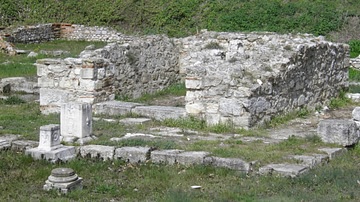
Dion Sanctuary of Zeus Hypsistos, Greece
The Sanctuary of Zeus Hypsistos at Dion in Macedonia (Greece) was a sanctuary with a single-roomed temple cella surrounded by a colonnade. A cult statue of Zeus was found in the naos of the temple of Zeus Hypsistos, next to its masonry base...

Image
Temple of Poseidon, Sounion, Greece
Temple of Poseidon (444-440 BCE), Sounion, Greece.

Image
Dion Houses of Zosa and Leda, Greece
The Houses of Zosa and Leda in Dion in Macedonia (Greece) are two private houses were located in the southeastern corner of the ancient city. Only a narrow road separated them from the southern city wall. Both houses were built around the...
Image
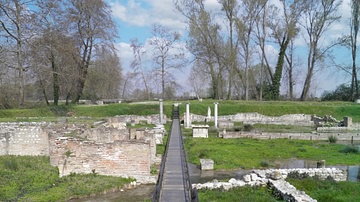
Dion Sanctuary of Isis, Greece
The Sanctuary of Isis at Dion in Macedonia (Greece) was built during the 2nd century CE over the ruins of an earlier sanctuary dedicated to Aphrodite and Artemis. It had a four-columned prostyle temple in its center dedicated to Isis Lochia...

Image
Pausanias' Description of Greece
Manuscript of Pausanias' Description of Greece at the Biblioteca Medicea Laurenziana in Florence, Italy, dating from 1485.
Image
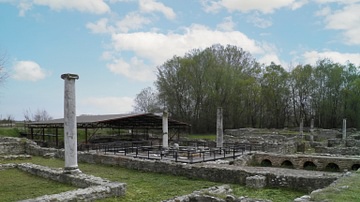
Dion Dionysus Villa, Greece
The Dionysus Villa in Dion in Macedonia (Greece) is a sprawling, luxurious private residence dating to the 2nd century CE. The villa complex was originally built with five interconnecting tetrastyle courtyards and atrium gardens. It was modified...

Image
Dion Monument of the Shields, Greece
The Monument of the Shields in Dion (Greece) is a monument alternating panels of shields and breastplates. These panels come from a frieze originally carved in the 4th century BCE for an unknown monumental Hellenistic building. The wall and...
Image
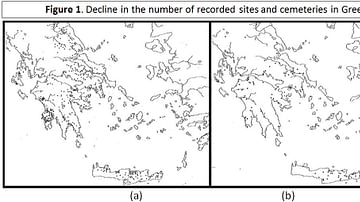
Figure 1 - Decline in the number of recorded sites and cemeteries in Greece
Recorded sites and cemeteries in Greece. (a) LH IIIB period , shows a total of 628 sites and cemeteries. (b) LH IIIC period, shows a total of 147, a reduction of slightly over 75% in the number of recorded sites and cemeteries. (Source...
Image
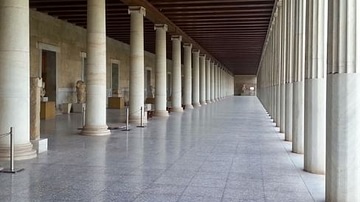
Roman Agora, Athens Greece
The Roman Agora, a modern-day replica of the ancient market place housing a museum highlighting local finds; Athens, Greece.
