
Search
Did you mean: Arabia?
Remove Ads
Advertisement

 This answer was generated by
 Search Results
Definition
Philip the Arab
Philip the Arab ruled as emperor of the Roman Empire briefly from 244 CE to 249 CE. In 244 CE Roman emperor Gordian III responded to an uprising in the eastern provinces instigated by the Persian king Shapur. Under the superb...

Image
Arab Room Tiles, Sintra Palace
Islamic ceramic tiles in the Arab Room in the Sintra palace (Palácio Nacional de Sintra), Portugal. King Manuel I of Portugal (r.1495-1521 CE) imported azulejos (glazed ceramic tiles) from the Alhambra palace in Granada...

Definition
Kahina
Kahina (7th century CE) was a Berber (Imazighen) warrior-queen and seer who led her people against the Arab Invasion of North Africa in the 7th century CE. She is also known as al-Kahina, Dihya al-Kahina, Dahlia, Daya, and Dahia-al-Kahina...
Image
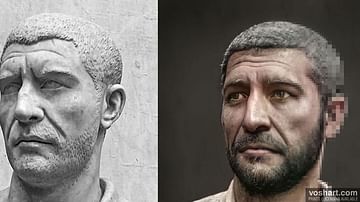
Philip the Arab (Artistic Facial Reconstruction)
A photorealistic representation of what the Roman emperor Philip the Arab (r. 244-249 CE) may have looked like. Based on contemporary and near contemporary descriptions, as well as archaeological evidence...
Image
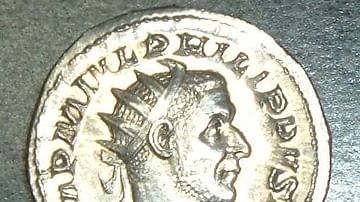
Roman Coin of Philip the Arab
A Roman Antoninianus coin from the reign of Marcus Julius Philipus, otherwise known as Philip the Arab, r. 244-249 CE.

Image
Roman Emperor Philip the Arab
Marble head of Roman Emperor Philip the Arab, from Rome, 244-249 CE. (Ny Carlsberg Glyptotek, Copenhagen)
Image
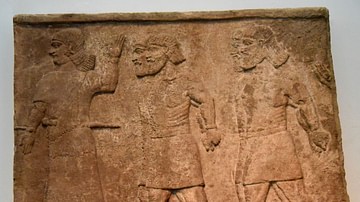
Review of Arab Prisoners, Assyrian Relief
Assyrian relief, from the Central Palace at Nimrud (ancient Kalhu), Mesopotamia, Iraq, Neo-Assyrian Empire, c. 728 BCE. This is part of a series of reliefs showing Arab prisoners brought before the Assyrian...
Image
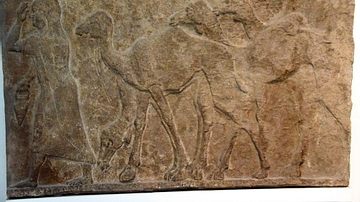
Captured Camels from Arab Enemies of Tiglath-pileser III
The woman on the left and the herd of camels behind her are part of a procession of prisoners and booty captured during one of the military campaigns of Tiglath-pileser III (reigned 744-727 BCE...

Image
Votive Head Mace of La-arab, King of Gutium
This partially mutilated head mace was inscribed with an Akkadian cuneiform script, which mentions that this stone head mace is a votive offering dedicated by La-arab, king of Gutium. Although they left little...

Image
Captured Flocks from Arab Enemies of Tiglath-pileser III
Sheep and goats, captured in a campaign against the Arabs are driven back to the Assyrian camp. This scene decorated the palace of King Tiglath-pileser III (reigned 744-727 BCE. Assyrian, about...
