
Search
Remove Ads
Advertisement
Search Results

Definition
Kievan Rus
Kievan Rus (862-1242) was a medieval political federation located in modern-day Belarus, Ukraine, and part of Russia (the latter named for the Rus, a Scandinavian people). The name Kievan Rus is a modern-day (19th century) designation...

Definition
Nikephoros II Phokas
Nikephoros II Phokas was Byzantine emperor from 963 to 969 CE. Known as “White Death of the Saracens,” Nikephoros was a fearsome commander who conquered Crete, Cilicia, and much of Syria. While he is known as a great military...
Definition
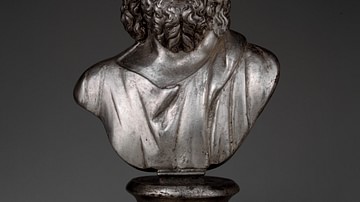
Serapis
Serapis is a Graeco-Egyptian god of the Ptolemaic Period (323-30 BCE) of Egypt developed by the monarch Ptolemy I Soter (r. 305-282 BCE) as part of his vision to unite his Egyptian and Greek subjects. Serapis’ cult later spread throughout...

Definition
Nephthys
Nephthys was one of the original five gods of ancient Egypt born of the union of Geb (earth) and Nut (sky) after the creation of the world. She was the fourth born after Osiris, Isis, and Set and was the older sister of Horus (usually...

Definition
John I Tzimiskes
John I Tzimiskes was Byzantine emperor from 969 to 976 CE. Although he took the throne by murdering his predecessor Nikephoros II Phokas, John was a popular emperor. A skilled general and a competent politician, he is known for...

Definition
Khosrow II
Khosrow II (aka Kosrau II, r. 590-628) was the last powerful shahanshah (king of kings) of the Sassanian Empire. Grandson of Kosrau I (r. 531-579) and near-conqueror of the Byzantine Empire in the Byzantine-Sassanian War of 602-628...

Definition
Timur - The Brutal Conqueror of Central Asia
Timur (1336-1405), also known as Tamerlane, Temür, or Timur Leng, was the founder of the Timurid Empire (1370-1507), which had its heartlands in modern-day Uzbekistan and capital at Samarkand. A Muslim Turkic...

Definition
Horus
Horus is the name of a sky god in ancient Egyptian mythology which designates primarily two deities: Horus the Elder (or Horus the Great), the last born of the first five original gods, and Horus the Younger, the son of Osiris and Isis...

Definition
Silk in Antiquity
Silk is a fabric first produced in Neolithic China from the filaments of the cocoon of the silk worm. It became a staple source of income for small farmers and, as weaving techniques improved, the reputation of Chinese silk spread...

Definition
The Crisis of the Third Century - A Pivotal Era of Ancient Rome
The Crisis of the Third Century (also known as the Imperial Crisis, 235-284) was the period in the history of the Roman Empire during which it splintered into three separate political entities...
