
Search
Remove Ads
Advertisement
Search Results

Image
Anglo-Maratha War Peace Conference
An 1805 illustration showing the peace conference which concluded the Anglo-Maratha Wars (1775-1819) between the East India Company and the Maratha Confederacy.
Image
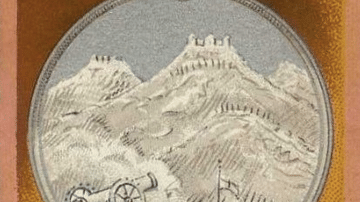
Anglo-Nepalese War Medal
Shown on a collectible cigarette card, the medal issued by the East India Company for participants in the Anglo-Nepalese War (1814-16).

Article
William the Conqueror & the Ely Rebellion
By early 1070 CE William I (r. 1066-1087 CE) had almost completed the Norman conquest of England. There remained threats from the border regions with Wales and Scotland but the north of England had finally...

Article
Battle of Edington
The Battle of Edington, fought in May 878 in southwest England, saw Alfred the Great, King of Wessex (r. 871-899), win a decisive victory over the Viking leader Guthrum (d. 890). Two weeks later, under the terms of the Treaty...
Definition
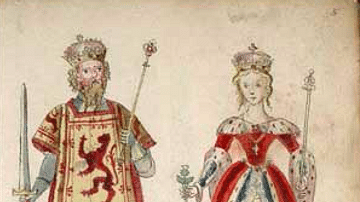
Malcolm III of Scotland
Malcolm III of Scotland (aka Máel Coluim mac Donnchada) reigned as king from 1058 to 1093 CE. He took the throne after his young predecessor Lulach (r. 1057-1058 CE), the stepson of Macbeth, king of Scotland (r. 1040-1057...

Definition
Alexander II of Scotland
Alexander II of Scotland reigned from 1214 to 1249 CE. Succeeding his father William I of Scotland (r. 1165-1214 CE), Alexander supported the northern barons in England against the unpopular King John of England (r. 1199-1216...

Definition
Emma of Normandy
Emma of Normandy (died 1052), the wife of King Aethelred the Unready from 1002 to 1016 and then the wife of King Cnut from 1017 to 1035, was a dominant player in English politics for nearly 50 years. Emma is the first English...

Definition
Spanish Armada
The 1588 Spanish Armada was a fleet of 132 ships assembled by King Philip II of Spain (r. 1556-1598) to invade England, his 'Enterprise of England'. The Royal Navy of Elizabeth I of England (r. 1558-1603) met the Armada in the...

Article
The Ancient Celtic Pantheon
The ancient Celtic pantheon consisted of over 400 gods and goddesses who represented everything from rivers to warfare. With perhaps the exception of Lugh, the Celtic gods were not universally worshipped across Iron Age...

Collection
France v England: The 100 Years' War
There was a bitter rivalry between France and England throughout the 14th and 15th century CE and their frequent battles in this period are now known to history as the Hundred Years' War (1337-1453 CE). In this...
