
Search
Remove Ads
Advertisement
Search Results
Article
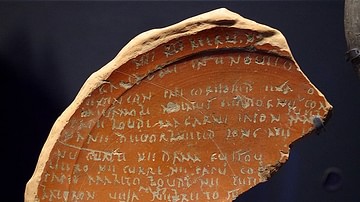
A Linguistical Analysis of Ancient Celtic Languages
The Celtic languages form a branch of the Indo-European (IE) language family. They derive from Proto-Celtic and are divided into Continental Celtic languages (Lepontic, Gaulish, Galatian, Noric, Celtiberian...

Definition
Agesilaus II
Agesilaus II (c. 445 – 359 BCE) was a Spartan king who won victories in Anatolia and the Corinthian Wars but who would ultimately bring total defeat to his city through his policies against Thebes. When Sparta lost the crucial battle...

Definition
Cassander
Cassander (c. 355-297 BCE, r. 305-297 BCE) was self-proclaimed king of Macedon during the political turmoil following Alexander's death. Born in Greece as the son of Antipater, the regent of Macedon and Greece in the absence of Alexander...

Video
Ancient Roman Games, Sports and Spectacles
The people of ancient Rome loved spectacles and, lucky for them, they could often be entertained by lavish public shows. The emperors of Rome knew of their people's love of spectacle so a way that they could...

Article
The Value of Family in Ancient Greek Literature
When looking at Ancient Greek literature, one can see the importance family plays in Greek culture. We see this displayed in the Greek works Medea by Euripides and Antigone by Sophocles. Throughout these...

Article
Women in Ancient Mesopotamia - Celebrating the Feminine Principle in the Near East
The lives of women in ancient Mesopotamia cannot be characterized as easily as with other civilizations, owing to the different cultures over time. Generally speaking, though...

Article
Female Gladiators In Ancient Rome
Female gladiators in ancient Rome – referred to by modern-day scholars as gladiatrix – may have been uncommon but they did exist. Evidence suggests that a number of women participated in the public games of Rome...

Definition
The Seven Wonders
The Seven Wonders of the Ancient World were seven impressive structures famously listed by ancient writers including Philo of Byzantium, Antipater of Sidon, Diodorus Siculus, Herodotus, Strabo, and Callimachus of Cyrene, among...

Definition
Wheel of the Year
The Wheel of the Year is a symbol of the eight Sabbats (religious festivals) of Neo-Paganism and the Wicca movement which includes four solar festivals - Winter Solstice, Spring Equinox, Summer Solstice, Fall Equinox - and four...

Collection
The Legacy of the Ancient Greeks
The ancient Greeks left the world such an impressive legacy of ideas that many of them were seen for centuries in the civilizations that followed and, even today, cultures around the world continue to display many...
