
Search
Remove Ads
Advertisement
Search Results

Image
Egyptian Hieroglyphics
Egyptian hieroglyphic inscription on wood, from the tomb of the general Horemheb. Saqqara, Egypt, c. 1300 BCE. Louvre Museum, Paris, France.

Image
Egyptian Priestess Takushit
Copper alloy with precious metal inlay statue of Egyptian priestess Takushit. 25th Dynasty, c. 670 BCE. Found near Alexandria. (National Archaeological Museum, Athens)
Image
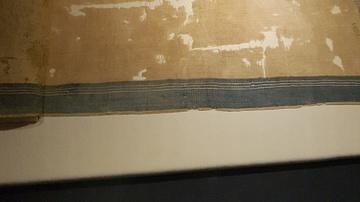
Egyptian Linen
A portion of Egyptian linen. Linen was the most common fabric used by embalmers to wrap the body, often in vast quantities. The woven blue bands on this piece suggest that it once formed part of a garment. New Kingdom to Late Period...

Article
Ancient Korean & Chinese Relations
Contact between Korea and China goes back to mythology and prehistory. Trade developed from the Bronze and Iron Ages with raw materials and manufactured goods going in both directions for centuries thereafter. In...

Video
Etruscan Religion: Influence on Rome
This video, originally related to a history research project, briefly describes Etruscan polytheistic religion as an overview. Further, it goes on to describe the influence of Etruscan religion on the future Roman...

Article
Reactions to Plague in the Ancient & Medieval World
Throughout history, epidemics and pandemics of plague and other diseases have caused widespread panic and social disorder even, in some instances, when the people of one region were aware of a pervasive...

Definition
Amarna Period of Egypt
The Amarna Period of ancient Egypt was the era of the reign of Akhenaten (1353-1336 BCE), known as 'the heretic king'. In the 5th year of his reign (c. 1348 BCE), he issued sweeping religious reforms which resulted in the...

Definition
Amarna
Amarna is the modern Arabic name for the site of the ancient Egyptian city of Akhetaten, capital of the country under the reign of Akhenaten (1353-1336 BCE). The site is officially known as Tell el-Amarna, so-named for the Beni Amran...

Image
Egyptian Broad Collar
Egyptian broad collar in faience. The broad collar is one of the most characteristic elements of ancient Egyptian jewellery. Called wesekh, which means 'the broad one', broad collars are often made up of different rows of...

Article
Ancient Christianity’s Effect on Society & Gender Roles
Christianity began as a sect of Judaism in Judea in the 1st century CE and spread to the cities of the Eastern Roman Empire and beyond. In these cities, non-Jews, Gentiles, wanted to join the movement...
