
Search
Remove Ads
Advertisement
Search Results

Definition
Todaiji
Todaiji is an ancient temple complex in Nara, Japan. Founded in 738 CE and officially opened in 752 CE when Nara was the capital, the temple is the headquarters of the Buddhist Kegon sect. The temple has a 500-ton sculpture of the Buddha...

Definition
Ninigi
Ninigi-no-Mikoto, or simply Ninigi, is the grandson of the supreme Shinto deity Amaterasu, the sun goddess. He is the son of Ama-no-Oshiho-mimi and, descending to earth as the first just ruler, he brought with him gifts from Amaterasu...

Definition
Gospel of John
In the canon of the New Testament, the fourth gospel of John is uniquely different from the other three, known as the Synoptics ("seen together"). Mark, Matthew, and Luke have parallel ministries and methods of relating the story...

Definition
Hestia
Hestia was the Greek virgin goddess of the hearth, home, and hospitality. In Greek mythology, she is the eldest daughter of Cronus and Rhea. In her role as a protector of the family and political community, sacrifices and offerings were...

Definition
Canaan
Canaan was the name of a large and prosperous ancient country (at times independent, at others a tributary to Egypt) located in the Levant region of present-day Lebanon, Syria, Jordan, and Israel. It was also known as Phoenicia. The origin...
Definition
Freyja
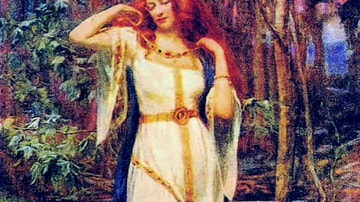
Freyja (Old Norse for 'Lady', 'Woman', or 'Mistress') is the best-known and most important goddess in Norse mythology. Beautiful and many-functioned, she features heavily as a fertility goddess stemming from her place in the Vanir family...

Definition
Kingdom of Nabatea
The Nabatean Kingdom was a powerful political entity which flourished in the region of modern-day Jordan between the 4th century BCE and c. 106 CE and is best known today for the ruins of its capital city of Petra. Although...

Definition
The Eumenides
The Eumenides is a play written by Aeschylus (c 525 – 455 BCE), the “Father of Greek Tragedy,” the most popular and influential of all tragedians of his era. The Eumenides was the third play of a trilogy, The Oresteia, with the...

Definition
Kingdom of Wessex
The Kingdom of Wessex (c. 519-927 or c. 519-1066) was a political entity founded by the West Saxon Chieftain Cerdic (r. 519-540) in 519 in the Upper Thames Valley of modern-day Britain which would later evolve into the modern...

Definition
Cathars
The Cathars (also known as Cathari from the Greek Katharoi for “pure ones”) were a dualist medieval religious sect of Southern France which flourished in the 12th century and challenged the authority of the Catholic Church. They were...
