
Search
Did you mean: Anastasios I?
Remove Ads
Advertisement

 This answer was generated by
Search Results

Image
Law of Anastasius I Dicorus
Marble slab inscribed in Greek. This is the law of the Byzantine Emperor Anastasius I Dicorus (reigned 491-518 CE), regulating the passage through Dardanelles customs. Byzantine Period, 6th century CE. From Abydos, Çanakkale...
Image
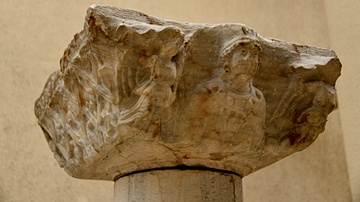
Impost Capital Depicting Anastasius I and Ariadne
This is a marble impost capital (or impost block). The short sides of this capital bear images of Empress Ariadne (borne 450, died 515 CE) and her Husband, the Byzantine Emperor, Anastasius I (reigned...

Image
Zeno I and Anastasius I
Emperors Zeno I and Anastasius I, folio 141 recto of the Nuremberg Chronicle (c. 1493).

Image
Emperor Anastasius I
Coin of Byzantine emperor Anastasius I, 491-518 CE.
Classical Numismatic Group, Inc. http://www.cngcoins.com

Image
Detail of Sutton Hoo's Anastasius Platter
This Byzantine silver platter is one of the largest to survive from the Byzantine Period. It measures almost 72 centimeters across and weighs 6.5 kilograms. The back is stamped with the control marks of Emperor...

Definition
Clovis I
Clovis I (or Chlodovech, 466-511/513 CE), king of the Franks, is considered the founding father of the Merovingian Dynasty, which would continue for over 200 years. Clovis became king at the age of 15, and by the time of his death 30...

Image
Flavius Anastasius Probus
Flavius Anastasius Paulus Probus Sabinianus Pompeius (consul 517 CE) in consular garb, holding a sceptre and the mappa, a piece of cloth used to signal the start of chariot races at the Hippodrome. Ivory panel from his...

Article
The Isaurians and the End of Germanic Influence in Byzantium
Germanic influence reigned in the Roman Empire from the end of the 4th century CE through the 5th. Germanic individuals took important posts in the government and the military, and Germanic...

Article
Hildegard of Bingen's Unknown Language and Unknown Letters
Sometime in 1153 or 1154, the German nun Hildegard of Bingen (1098-1179) wrote a letter to the elderly Pope Anastasius IV (1073-1154). Her words were scathing. She called the pope tired and criticized...

Definition
Emperor Zeno
Zeno was Byzantine emperor from 474 until 491 CE. An ethnic Isaurian, Zeno was repeatedly criticized as an outsider during his reign, which was full of rebellions and attacks by the Ostrogoths. He is best known for his failed attempt...
