
Search
Did you mean: Amenhotep III?
Remove Ads
Advertisement
Search Results

Definition
Phoenician Art
The art of the ancient Phoenicians, which flourished between the 19th and 4th centuries BCE, was exported throughout Mesopotamia and the ancient Mediterranean. Best known for their work on small decorative objects, Phoenician artists...

Definition
Roman Gladiator
A Roman gladiator was an ancient professional fighter who usually specialised with particular weapons and types of armour. They fought before the public in hugely popular organised games held in large purpose-built arenas throughout...

Definition
Carthaginian Art
The art of the Carthaginians was an eclectic mix of influences and styles, which included Egyptian motifs, Greek fashion, Phoenician gods, and Etruscan patterns. Precious metals, ivory, glass, terracotta, and stone were transformed...

Definition
Protagoras
Protagoras of Abdera (l. c. 485-415 BCE) is considered the greatest of the Sophists of ancient Greece and the first philosopher in the West to promote Subjectivism, arguing that interpretation of any given experience, or anything...

Definition
Timoleon
Timoleon (c. 411 - c. 337 BCE) was a Corinthian statesman and general who famously defeated the tyrant of Syracuse Dionysius II and an army of Carthage against the odds. Permanently settling on the island, he re-organized the governments...

Definition
Sulla
Lucius Cornelius Sulla (138-78 BCE) was a ruthless military commander, who first distinguished himself in the Numidian War under the command of Gaius Marius. His relationship with Marius soured during the conflicts that would follow and...

Definition
Carthaginian Army
The armies of Carthage permitted the city to forge the most powerful empire in the western Mediterranean from the 6th to 3rd centuries BCE. Although by tradition a seafaring nation with a powerful navy, Carthage, by necessity...

Definition
Aspasia of Miletus
Aspasia of Miletus (l. c. 470-410/400 BCE) is best known as the consort of the great Athenian statesman Pericles. Her life story has always been given in the shadow of Pericles' fame, but she was a woman of great eloquence and...
Definition
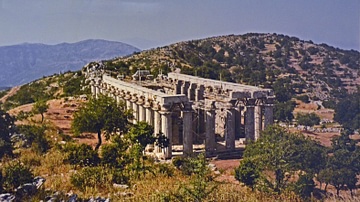
Bassae
Bassae (Bassai), located in south-west Arcadia on the slopes of Mt. Kotilion, was an important temple site in the Archaic and Classical periods. Its large 5th-century BCE temple of Apollo, now covered with a permanent roof, is one of...

Definition
Sidon
Sidon is the Greek name (meaning 'fishery') for the ancient Phoenician port city of Sidonia (also known as Saida) in what is, today, Lebannon (located about 25 miles south of Beirut). Along with the city of Tyre, Sidon was the most powerful...
