
Search
Remove Ads
Advertisement
Search Results

Definition
Cassander
Cassander (c. 355-297 BCE, r. 305-297 BCE) was self-proclaimed king of Macedon during the political turmoil following Alexander's death. Born in Greece as the son of Antipater, the regent of Macedon and Greece in the absence of Alexander...

Definition
January Uprising of 1863 - Polish Rebellion Against Russian Rule in Poland
The January Uprising of 1863 was a conflict between Tsarist Russia and Polish insurgents striving for independence. The uprising continued until October 1864, when it was suppressed by the Russian forces, effectively erasing the already limited...

Article
The Hyphasis Mutiny
The so-called Hyphasis Mutiny was a conflict between Alexander the Great (356-323 BCE) and his army following their victory at the river Hydaspes in 326 BCE. Alexander voiced plans for further conquests in the Indian subcontinent, however...

Article
The Battle of Gaugamela, 331 BCE
After securing the eastern Mediterranean seaboard and Egypt, Alexander the Great pushed east into Mesopotamia with the intention of bringing Darius to battle. After crossing the Euphrates River unopposed, he marched his army eastward along...

Collection
Russia in Revolution 1905-17
In the early years of the 20th century, the Russian Empire, ruled by Tsar Nicholas II (reign 1894-1917), faced increasing unrest from within by all sections of society. The peasantry, working classes, middle classes, and nationalist movements...
Image
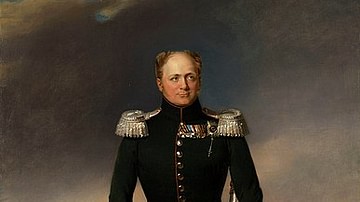
Alexander I, Emperor of Russia
Emperor Alexander I of Russia (r. 1801-1825), oil on canvas portrait by George Dawe, c. 1818-1825.
British Royal Collection.
Interview
Interview: Jeanne Reames on Dancing with the Lion
Dr. Jeanne Reames' Dancing with the Lion: Becoming and Dancing with the Lion: Rise follow an epic tale of Alexander before he was “The Great.” In this interview, Dylan Campbell inquires about her passion for history and the development of...

Definition
Wars of the Diadochi
On June 10, 323 BCE Alexander the Great died in Babylon. Although historians have debated the exact cause most agree that the empire he built was left without adequate leadership for there was no clear successor or heir. The military commanders...

Definition
Russian Revolution of 1905
The Russian Revolution of 1905 challenged the absolute power of Tsar Nicholas II (reign 1894-1917) as ruler of the Russian Empire. Bloody Sunday in 1905 started the year disastrously for the tsar when soldiers fired upon an unarmed crowd...

Article
Causes of the Russian Revolution of 1917
There were many causes behind the Russian Revolution of 1917, ranging from the unpopular authoritarian rule of Tsar Nicholas II (reign 1894-1917) to the radical mobilisation of the working class, who wanted better working conditions and more...
