
Search
Did you mean: Altamira?
Remove Ads
Advertisement
Search Results
Image
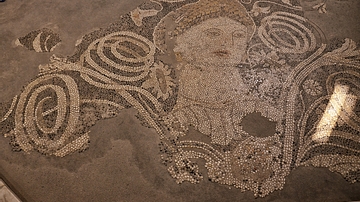
The Beauty of Durrës Mosaic
Mosaic called "The Beauty of Durrës", from Epidamnos/Dyrrhachium, 4th century BCE. National Museum of History in Tirana, Albania.
Image
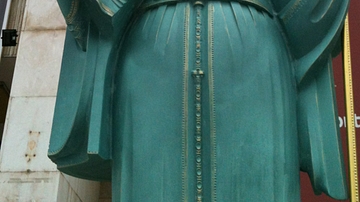
Statue of Queen Teuta
Statue of the Illyrian Queen Teuta (r. 231-227 BCE) and Pinnes in Tirana, Albania

Image
Hellenistic Gate, Butrint
A gate entrance in the Hellenistic fortification walls of Butrint (modern Albania), 2nd century BCE. Constructed using large ashlar blocks with angled joins designed to minimise earthquake damage. Despite this precaution...

Image
Roman Opus Mixtum Wall
A segment of typical 2nd century CE Roman wall from Butrint (modern Albania). The wall is in the opus mixtum style which combined layers of opus testaceum (standard brick facing) with opus reticulatum (square-based pyramid...
Image
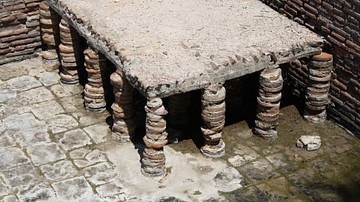
Roman Baths Floor, Butrint
A section of the Roman baths flooring at Butrint (modern Albania), 2nd century CE. The brick piles allowed for the circulation of warm air to heat the baths.
Image
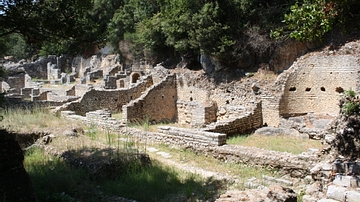
Roman Forum, Butrint
Remains of shop buildings in the roman forum at Butrint (modern Albania), 2nd century CE.
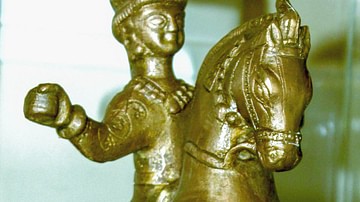
Image
King Javanshir of Arran
Statue of Arranshah Juansher (Pahlavi) (King Javanshir of Caucasus Albania), 637-669. A copy of the bronze sculpture of Javanshir at the National Museum of History of Azerbaijan. The original work is kept at the Hermitage...
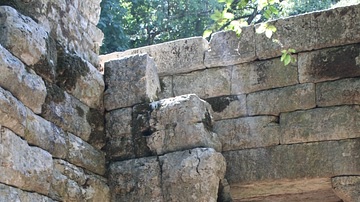
Image
Fortification Gate, Butrint
A gate in the fortification walls of Butrint (modern Albania), 2nd century BCE. The lintel shows a lion devouring a bull carved in relief and was probably reused from an earlier 6th century BCE building. The gate was...
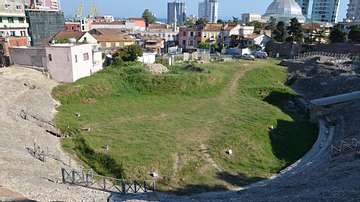
Image
Amphitheatre of Durrës (Dyrrachium)
The Amphitheatre of Durrës (Roman Dyrrachium) in Albania was built in the 2nd century CE and held 15,000 to 20,000 people. It is among the largest monuments of antiquity to have survived on Albanian territory.
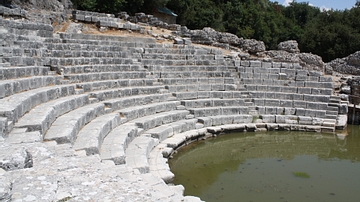
Image
Seating, Theatre of Butrint
The theatre of Butrint (modern Albania), early 2nd century BCE.
