
Search
Remove Ads
Advertisement
Search Results

Definition
Neo-Assyrian Empire
The Neo-Assyrian Empire (912-612 BCE) was the final stage of the Assyrian Empire, stretching throughout Mesopotamia, the Levant, Egypt, Anatolia, and into parts of Persia and Arabia. Beginning with the reign of Adad Nirari...

Definition
Early Joseon Period
The Early Joseon Period (1392 - c. 1550 CE) in Korea was bookended by internal power struggles but witnessed major scientific and societal advances and prosperity. The Joseon (Choson) Dynasty ruled Korea from 1392 CE to 1897...
Definition
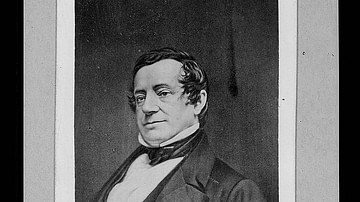
Washington Irving
Washington Irving (1783-1859) was an American author, essayist, and diplomat best known for his short stories The Legend of Sleepy Hollow and Rip Van Winkle. He was the first professional American author and also the first to...

Definition
Attila the Hun
Attila the Hun (r. 434-453 CE) was the leader of the ancient nomadic people known as the Huns and ruler of the Hunnic Empire, which he established. His name means "Little Father" and, according to some historians, may not have...

Definition
Eridu Genesis - The Oldest Mesopotamian Text on the Great Flood
The Eridu Genesis (also known as the Sumerian Flood Story, The Flood Story, Sumerian creation myth, Sumerian deluge myth) is the oldest Mesopotamian text relating the tale of the Great Flood...

Definition
Gojoseon
Gojoseon (Gochoson or Old Choson) was an ancient kingdom which ruled northern Korea in the second half of the first millennium BCE. Gojoseon possessed the most advanced culture in the Korean peninsula at that time and was an important...

Definition
Saint Boniface
Saint Boniface (born as Wynfreth, l. 672-754) is one of the most famous saints in the Netherlands. He helped Pope Gregory II (r. 715-731), who was keen to convert pagan Germanic tribes, to achieve his goal, the Christianization...

Definition
Thracian Art
The art produced by the people of Thrace, as indicated by the many precious objects found in Thracian tombs dating from the Bronze Age onwards, was, like the culture itself, a mix of indigenous ideas and foreign influences. Although...

Definition
Amphora
An amphora (Greek: amphoreus) is a jar with two vertical handles used in antiquity for the storage and transportation of foodstuffs such as wine and olive oil. The name derives from the Greek amphi-phoreus meaning 'carried on both sides'...

Definition
Carthago Nova
Carthago Nova (modern-day Cartagena) was a city on the southern Iberian Peninsula, Spain, originally known as Mastia. Human habitation of the region predates the Neolithic Period, but the area around the site of Carthago Nova seems...
