
Search
Did you mean: Adad Nirari I?
Remove Ads
Advertisement
Search Results

Article
Byzantine Icons
Icons, that is images of holy persons, were an important part of the Byzantine Christian Church from the 3rd century CE onwards. Venerated in churches, public places, and private homes, they were often believed to have protective...

Video
Richard III - The Archaeological Dig
http://www.le.ac.uk/richardiii - Richard III Educational Resources Project manager Richard Buckley from University of Leicester Archaeological Services (ULAS) discusses the 'Greyfriars Project', the excavation...
Image
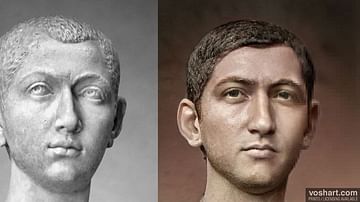
Gordian III (Artistic Facial Reconstruction)
A photorealistic representation of what the Roman emperor Gordian III (r. 238-244 CE) may have looked like. Based on contemporary and near contemporary descriptions, as well as archaeological evidence. Pictured...
Image
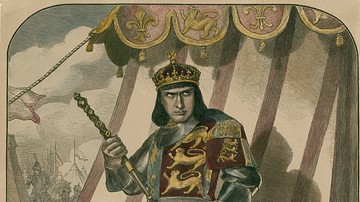
Edwin Booth as Richard III
Edwin Booth, famous 19th-century American actor, brother of John Wilkes Booth, as Richard III of England, the protagonist of William Shakespeare's The Tragedy of Richard III. Print by Henry Duff Linton, 1872. Folger Shakespeare...

Image
Demolition of the Monument to Alexander III in Moscow
Photograph of the demolition of the monument to Alexander III in Moscow, July 1918. As Tsarist Russia fell in 1917, so did the monuments of its monarchs. The colossal bronze statue to Alexander III...
Image
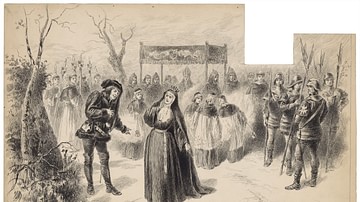
Richard III Woos Lady Anne - Richard III, Act I Scene II
Richard III of England woos Lady Anne Neville in Act I Scene II of William Shakespeare's The Tragedy of Richard III (c. 1594), drawing by Herbert Railton, circa 1890.
Folger Shakespeare Library.

Image
Map of the Assyria in the Middle Assyrian Period - Campaigns and Rival Powers in the Late Bronze Age
The Middle Assyrian period (c. 1365–1000 BCE) emerged from the shifting balance of power in the Late Bronze Age Near East. After earlier subordination to Mitanni...
Article
Twelve Great Women of Ancient Persia
Women in ancient Persia had more rights and greater freedom than any other ancient civilization including, according to some scholars, even ancient Egypt which is famous for its respect for the feminine principle...

Article
The Siege of Damascus, 1148 CE
The siege of Damascus in 1148 CE was the final act of the Second Crusade (1147-1149 CE). Lasting a mere four days from 24 to 28 July, the siege by a combined western European army was not successful, and the Crusade...

Article
Legions of Judea
Judea was initially dependent on its neighbor Syria for military support until it received a Roman legion of its own in 70 CE after the Great Jewish Revolt of 66 CE. Legio X Fretensis was stationed at remains of the burned city...
