
Search
Did you mean: Hachiman?

 This answer was generated by
 Search Results

Definition
Achaean League
The Achaean League (or Achaian Confederacy) was a federation of Greek city-states in the north and central parts of the Peloponnese in the 3rd and 2nd centuries BCE. With a combined political representation and land army, the successful early...
Image
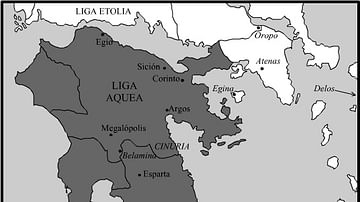
Achaean League c. 200 BCE
The Achaean League was a Hellenistic period confederation of Greek city states on the northern and central Peloponnese between 280 BCE and 146 BCE.
Image
Achaean League c. 150 BCE
The Achaean League was a Hellenistic period confederation of Greek city states on the northern and central Peloponnese between 280 BCE and 146 BCE.
Definition
Thersites
Thersites is a character in the Iliad who made a stand against Agamemnon and the enterprise of the Trojan War. Homer chose to add Thersites’ speech after Achilles’ infamous dispute with Agamemnon, probably to emphasize the struggles that...

Definition
Achilles
Achilles is a figure from Greek mythology and literature and star of the Trojan War. Leader of the fearsome Myrmidons, sacker of cities, and slayer of Hector, godlike Achilles was quite simply invincible in battle. Only the divine intervention...

Definition
Aetolian League
The Aetolian League was an ancient Greek alliance of the tribes that lived west of Athens and north of the Peloponnese. The league was probably first established in the early 4th century BCE, reached its peak during the Hellenistic Period...

Definition
Oenone
Oenone was a nymph in Greek Mythology, the daughter of the river god Cebren and sister of the nymph Asterope/Hesperia. She was given the gift of prophecy by Rhea (mother of the gods) and the gift of healing by Apollo. Her name comes from...

Definition
Mythology
Myths are a part of every culture in the world and are used to explain natural phenomena, where a people came from and how their civilization developed, and why things happen as they do. At their most basic level, myths comfort by giving...

Definition
Despotate of the Morea
The Despotate of the Morea was a semi-autonomous appanage of the later Byzantine Empire. The Byzantines retook part of the Peloponnese in Southern Greece in 1262 CE, but the Morea was only officially governed by semi-autonomous despots of...

Definition
Mystras
The city of Mystras (or Mistras) in southern Greece was the provincial capital of the Byzantine Despotate of the Morea from the 13th through the 15th centuries CE. It was founded in 1249 CE by William II of Villehardouin, and it served as...
