
Search
Remove Ads
Advertisement
Search Results

Article
Continuity and Change after the Fall of the Roman Empire
The cataclysmic end of the Roman Empire in the West has tended to mask the underlying features of continuity. The map of Europe in the year 500 would have been unrecognizable to anyone living a hundred years earlier. Gone was the solid boundary...

Definition
Faravahar
The faravahar is the best-known symbol from ancient Persia of the winged sun disk with a seated male figure in the center. It is thought to represent Ahura Mazda, the god of Zoroastrianism, but has also been interpreted to signify other concepts...

Definition
Christianity
Christianity is the world's largest religion, with 2.8 billion adherents. It is categorized as one of the three Abrahamic or monotheistic religions of the Western tradition along with Judaism and Islam. 'Christian' is derived from the Greek...

Definition
Zorvanism
Zorvanism (also given as Zuvanism, Zurvanism) was a sect of the Persian religion Zoroastrianism which emerged in the late Achaemenid Empire (c. 550-330 BCE) and flourished during the Sassanian Empire (224-651 CE). It is often referenced as...

Article
Ten Ancient Rome Facts You Need to Know
Ancient Roman culture affected vast numbers of people across the known world of its time, beginning with the rise of the Roman Republic (509-27 BCE) and throughout the duration of the Roman Empire (27 BCE - c. 476 CE in the West and 1453...

Definition
Zoroastrianism
Zoroastrianism is the monotheistic faith established by the Persian prophet Zoroaster (also given as Zarathustra, Zartosht) between c. 1500-1000 BCE. It holds that there is one supreme deity, Ahura Mazda (Lord of Wisdom), creator and sustainer...

Article
This Barking Dog - Religion and Homosexuality in the Works of Christopher Marlowe
On 5 May 1593, a series of anti-Protestant bills were posted throughout the city of London. One of the bills was written in iambic pentameter and included several references to the works of celebrated poet Christopher Marlowe (1564-1593...

Article
Henry IV of France & the Edict of Nantes
Henry of Navarre became the nominal ruler of France after the assassination of Henry III of France (r. 1574-1589), whose marriage to Louise de Lorraine produced no heir. After years of attempts to deny the throne to Navarre, his enemies realized...

Definition
Ancient Celts
The ancient Celts were various tribal groups living in parts of western and central Europe in the Late Bronze Age and through the Iron Age (c. 700 BCE to c. 400 CE). Given the name Celts by ancient writers, these tribes and their culture...
Article
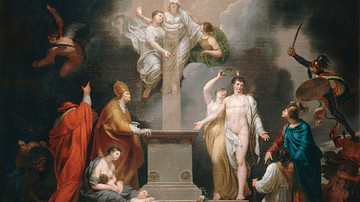
Napoleonic Concordat of 1801 & Religious Pluralism
The Napoleonic Concordat of 1801 defined France's relationship with the Catholic Church for over 100 years. The Organic Articles were added in 1802 and provided state recognition of the Reformed and Lutheran confessions alongside the Catholic...
