
Search
Remove Ads
Advertisement
Search Results
Definition
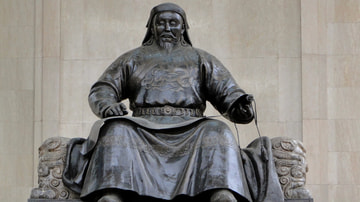
Kublai Khan
Kublai Khan (Qubilai-Qan) was the ruler of the Mongol Empire from 1260 to 1294. His accomplishments include establishing Mongol rule in China under the name of the Yuan Dynasty (1271-1368), thus becoming the first non-Chinese to rule...

Definition
Roman Empire
The Roman Empire, at its height (c. 117), was the most extensive political and social structure in western civilization. Building upon the foundation laid by the Roman Republic, the empire became the largest and most powerful political...

Definition
The Ankh
The Ankh is one of the most recognizable symbols from ancient Egypt, known as "the key of life" or "cross of life" and dated to the Early Dynastic Period (c. 3150 - 2613 BCE). It is a cross with a loop at the top sometimes ornamented...

Definition
Early Joseon Period
The Early Joseon Period (1392 - c. 1550 CE) in Korea was bookended by internal power struggles but witnessed major scientific and societal advances and prosperity. The Joseon (Choson) Dynasty ruled Korea from 1392 CE to 1897...

Image
Statuette of Priest Renefres from Egypt
This limestone statuette depicts the pure-priest Renefres, son of the lady Senebi. He appears striding. Middle kingdom, 18th Dynasty, 1543-1292 BCE. The Petrie Museum of Egyptian Archaeology, London (With thanks...

Definition
Ashurbanipal
Ashurbanipal (r. 668-627 BCE, also known as Assurbanipal) was the last of the great kings of Assyria. His name means "the god Ashur is creator of an heir" and he was the son of King Esarhaddon of the Neo-Assyrian Empire. In the Hebrew...

Image
Floral Frieze from Ancient Egypt
Although the use of glazed tiles and colored paste inlays is known from as early as the Old Kingdom, the apogee of their use came during the New Kingdom. An almost identical frieze of lotuses, other flowers, and grape...
Image
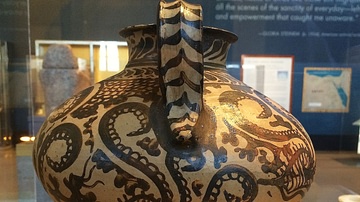
Minoan Decorated Jug Found in Egypt
One of the world's most famous works of Minoan pottery, this vessel shows five mollusks called nautili floating above the seafloor. The sinuous undulating lines of the water plans and nautili tentacles clearly...

Image
Theophany Hymn from Egypt
This is the recto of a double hymn, written on papyrus, with double vowels for musical purposes. This one mentions the Baptism of Jesus in Jordan. The order of the words follows the gospel of John. From Egypt, precise...

Image
Portrait of Ptolemy I or II of Egypt
This limestone portrait from the Early Ptolemaic Period (323-246 BCE) depicts either Ptolemy I or Ptolemy II of Egypt. Exact provenance is unknown. (Royal Ontario Museum, Toronto)
