
Search
Remove Ads
Advertisement
Search Results
Image
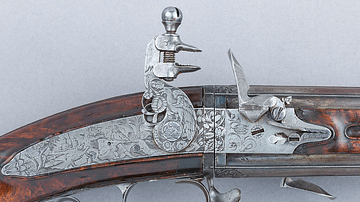
17th-Century Flintlock Mechanism
An example of a 17th-century flintlock firearm mechanism. A piece of flint was held in the vice which the trigger pulled down to strike a metal bar which created a spark to ignite the priming powder which then set off the main charge of gunpowder...
Image
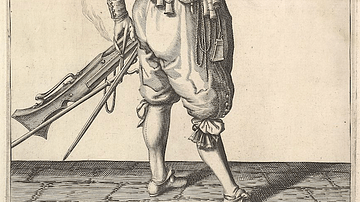
17th-century Musketeer Loading His Weapon
An illustration of a 17th-century musketeer loading his weapon. From a series of engravings in a Dutch 1608 arms manual The Exercise of Arms. (Metropolitan Museum of Art, New York)

Image
17th-Century Siege Artillery Tactics
An early 17th-century illustration by Johann Jacob von Wallhausen showing the tactics of batteries of siege artillery to fire upon a specific point in the defensive fortifications.
Image
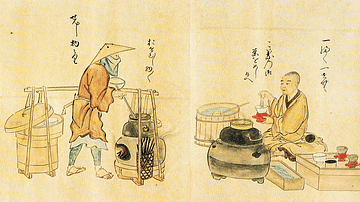
17th-century Japanese Tea Vendors
A print showing Japanese tea vendors. Edo Period, c. 1846, print from a 1632 original. Copied by Kanō Osanobu and Kanō Masanobu. (From Poetry Competition of Artisans, vol.2)

Definition
The Crisis of the Third Century - A Pivotal Era of Ancient Rome
The Crisis of the Third Century (also known as the Imperial Crisis, 235-284) was the period in the history of the Roman Empire during which it splintered into three separate political entities: the Gallic Empire, the Roman Empire, and the...

Article
Enemies of Rome in the 3rd Century CE - The Greatest Enemy of Rome was Rome Itself
It has been said that the greatest enemy of Rome was Rome itself, and this is certainly true of the period known as the Crisis of the Third Century (also known as the Imperial Crisis, 235-284). During this time of almost 50 years, over 20...

Article
Global Trade in the 13th Century
In the 13th century, astonishing quantities of spices and silk passed from the Far East to Europe. Exact amounts are not known, but spice popularity in both cuisine and medicine reached its historical peak during the Middle Ages in Europe...

Article
Interview: Refugees & Reformation in 16th-Century Frankfurt
In the 16th century, German cities and territories welcomed thousands of refugees fleeing the religious persecution sparked by the Protestant Reformation. In Strange Brethren: Refugees, Religious Bonds, and Reformation in Frankfurt, 1554-1608...

Article
How Christmas Was Shaped by 19th-Century Literature
How we celebrate Christmas today is largely shaped by a small group of authors who recorded festive traditions in the 19th century. These authors include Washington Irving (1783-1859), Clement Clarke Moore (1779-1863), and Charles Dickens...
Article
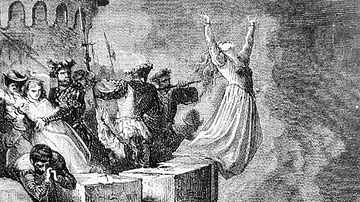
The Sixteenth-Century Massacre of the Waldensians of Mérindol
As the Reformation developed in France in the first half of the 16th century, there were several episodes of severe repression which preceded the Wars of Religion (1562-1598). These were times of great hardship and oppression against those...
