
Search
Search Results
Definition
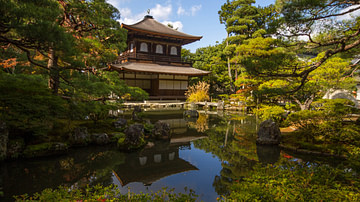
Ginkakuji
The Ginkakuji Temple in Kyoto, Japan, formally referred to as Jisho-ji and otherwise known as 'The Serene Temple of the Silver Pavilion', was first built in the 15th century CE. It is a Rinzai Zen temple with the complex consisting of the...

Definition
Teng Shih
Teng Shih (l. c. 500 BCE) was a Chinese Sophist and lawyer who lived and wrote in the province of Cheng (Pengcheng, modern-day Xuzhou, Jiangsu province) during the era of the Spring and Autumn Period (c. 772-476 BCE) which preceded the Warring...
Image
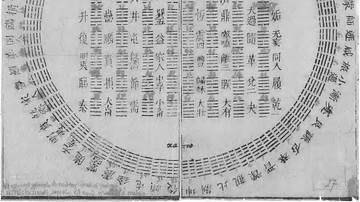
I-Ching Hexagrams
A page illustrating the various hexagrams used with the I-Ching (c. 1150-1250 BCE), or Book of Changes. This book is still available today providing a reader with interpretations for certain hexagrams which tell the future. (1701 CE, Leibniz...

Article
Mongol Multiculturalism
The Mongol Empire accepted and promoted many other cultures. Historians often talk about cultural exchange across Asia in the Mongol Empire as something that was just facilitated by peace and stability across such a huge area – the 'Pax Mongolica'...
Article
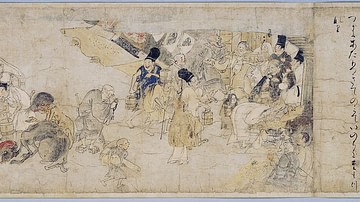
Ghosts in Ancient China
Ghost stories were the earliest form of literature in ancient China. They were almost certainly part of a very old oral tradition before writing developed during the Shang Dynasty (1600-1046 BCE) and they continue to be popular in China today...

Article
Pigs in Ancient China
Pigs (sometimes called “suids” of the suidae family) have long played an important part in Chinese culture. Pigs symbolize good fortune and happiness as they seem to live a care-free existence and have a long relationship with the humans...
Article
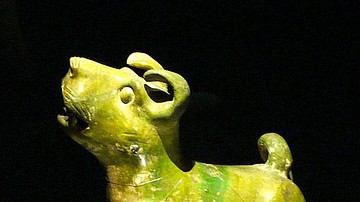
Dogs in Ancient China
Dogs are the oldest domesticated animal in China and were bred as guardians, for transporting goods, for herding, hunting, and as a food source. Archaeological evidence dates the domestication of the dog in China at approximately 15,000 years...

Image
Map of the Shang Dynasty of China, c. 1100 BCE - Bronze, Kingship, and Networks in the Yellow River World
The Shang dynasty (c. 1600–1046 BCE) represents one of the earliest historically attested states in China, emerging in the Yellow River basin after the period traditionally associated with the Xia. Rather than a territorially unified state...
Definition
Goryeo
Goryeo (Koryo) ruled Korea from 918 to 1392. The kingdom oversaw an unprecedented flourishing in culture and arts with developments in architecture, ceramics, printing, and papermaking. The kingdom was repeatedly invaded by the Mongols in...

Definition
The Art of War
The Art of War (Sunzi bingfa) is a 5th-century BCE military treatise written by the Chinese strategist Sun-Tzu (aka Sunzi or Sun Wu). Covering all aspects of warfare, it seeks to advise commanders on how to prepare, mobilise, attack, defend...
