
Search
Search Results

Definition
Eris
Eris is the Greek goddess and personification of discord and strife. She is an unpopular figure in Greek mythology due to her problematic behaviour and her ability to stir up trouble wherever she goes. Eris is most famous for her Golden Apple...

Definition
Ancient Korean Architecture
The architecture of ancient Korea is epitomised by the artful combination of wood and stone to create elegant and spacious multi-roomed structures characterised by clay tile roofing, enclosures within protective walls, interior courtyards...

Definition
Jade Emperor
The Supreme August Jade Emperor is the supreme deity of Chinese tradition and is otherwise known as Yuhuang Shangdi (Yu-huang Shang-ti), Yudi (Yu Ti) or Mr. Heaven (Lao-t'ien ye). He governs the cosmos and resides in a magnificent palace...

Definition
Sima Qian
Sima Qian (l. 145/135-86 BCE) was a court scribe, astrologer, and historian of the Han Dynasty (202 BCE - 220 CE) of ancient China, famous for his historical work Records of the Grand Historian for which he is remembered as the Father of...
Definition
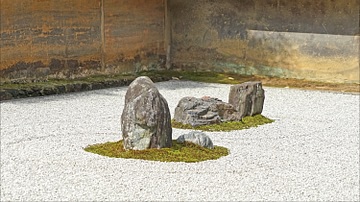
Ryoanji
Ryoanji (Ryōan-ji) is a Zen Buddhist temple in Kyoto, Japan which is today most famous for its Zen rock garden with its enigmatic arrangement of stones. Founded in the 15th century CE, the temple is one of the most visited tourist spots in...

Definition
Xunzi
Xunzi (pronounced shund-zee, l. c. 310-c. 235 BCE) was a Confucian philosopher of the Warring States Period (c. 481-221 BCE) in China. He is also known as Hun Kuang, Hsun Tzu, Xun Tzu, and Xun Kuang. Xunzi translates as Master Xun and is...

Definition
Choe Chiwon
Choe Chiwon (857-915 CE) was a celebrated poet and scholar of the Unified Silla kingdom which ruled Korea from 668 to 935 CE. Choe Chiwon adopted the pseudonym or brush name 'Orphan Cloud' and he became the most celebrated scholar-official...

Article
Women in Ancient China
Women in ancient China did not enjoy the status, either social or political, afforded to men. Women were subordinate to first their fathers, then their husbands, and finally, in the case of being left a widow, their sons in a system known...

Article
Religion in the Mongol Empire
The Mongol Empire (1206-1368 CE) covered Asia from the Black Sea to the Korean peninsula and so naturally included all manner of religions within its borders, but the Mongols themselves had their own particular religious beliefs and rituals...

Article
Chariots in Ancient Chinese Warfare
The chariot was used in Chinese warfare from around 1250 BCE but enjoyed its heyday between the 8th and 5th century BCE when various states were constantly battling for control of China. Employed as a status symbol, a shock weapon, to pursue...
