
Search
Remove Ads
Advertisement
Search Results

Definition
Johannes Hevelius
Johannes Hevelius (1611-1687) was a Polish astronomer based in Danzig (Gdańsk). He worked from his own privately funded observatory, creating maps of the Moon's surface, discovering the first variable star, and spotting several new comets...

Definition
Cheomseongdae
Cheomseongdae (Chomsongdae) is a 7th-century CE observatory tower located in Gyeongju, the capital of the Silla Kingdom of ancient Korea. It is the oldest surviving astronomical observatory in East Asia and is listed as no. 31 on the official...

Lesson Pack
Arts & Culture in Ancient Greece
We have prepared four lesson plans including classroom activities, assignments, homework, and keys as well as: - Multiple choice quiz questions in an excel format. - Glossary of keywords and concepts in an excel format. - Open questions...
Collection
The Art & Culture of Ancient Greece
The ancient Greeks were masters at picking up ideas from other cultures, mixing these with their own innovations and producing unique contributions to world culture. Greek sculptors adored the human form, painters loved to tell stories on...

Video
Lego Antikythera Mechanism
The Antikythera Mechanism: http://bit.ly/fm4oFK is the oldest known scientific computer, built in Greece at around 100 BCE. Lost for 2000 years, it was recovered from a shipwreck in 1901. But not until a century later was its purpose understood...

Article
The Telescope & the Scientific Revolution
The invention of the telescope in 1608 is usually credited to the Dutchman Hans Lippershey. The astronomical telescope became one of the most important of all instruments during the Scientific Revolution when figures like Galileo (1564-1642...

Article
Astronomy in the Scientific Revolution
The astronomers of the Scientific Revolution rejected long-held theories of ancient thinkers like Claudius Ptolemy and Aristotle and instead set out to systematically observe the heavens in order to create a model of the universe that fit...

Article
Observatories in the Scientific Revolution
The foundation of observatories during the Scientific Revolution (1500-1700) followed a process of evolution from entirely independent observatories operated by a single astronomer to private observatories which received state or private...

Article
Jesuit Influence on Post-medieval Chinese Astronomy
Ancient China had seen little Western contact before the 16th century CE, the language, culture and science all being allowed to develop independently of foreign influence. By the time European Jesuit missionaries arrived in the 16th century...
Image
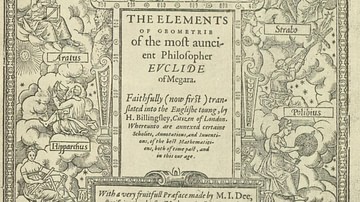
First English version of Euclid's Elements, 1570
Title page of Sir Henry Billingsley's first English version of Euclid's Elements, 1570.
