Celebrate Our Anniversary with Trivia!
Join us on August 23 for a free virtual trivia party featuring questions about ancient civilizations, U.S. history, unusual historical facts, pop culture, and more.
$0 / $5000
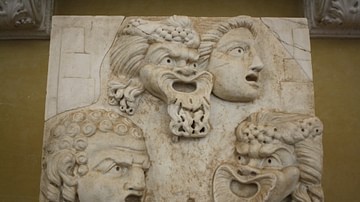
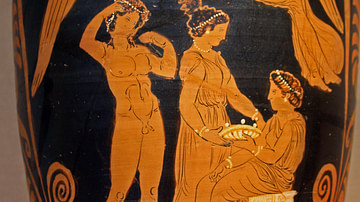
Greek theatre likely sprang from the lyrical performance of ancient epic poetry and the rituals performed in the worship of the god Dionysos where goats were sacrificed and participants wore masks. From the 6th century BCE, Greek tragedy plays were performed in open-air theatres at religious festivals and this format would lead to the new genre of Greek comedy plays. In this collection of resources, we examine the origins of Greek drama in detail, the particular design of greek theatres, the innovations made by the most famous playwrights, and their most celebrated individual works. The use of actors wearing masks and costumes supported by a chorus of singers and musicians, all performed on a stage in front of an appreciative audience has become, of course, one of the most enduring artistic legacies of the ancient Greeks.
The early tragedies had only one actor who would perform in costume and wear a mask, allowing him the presumption of impersonating a god. Here we can see perhaps the link to earlier religious ritual where proceedings might have been carried out by a priest. Later, the actor would often speak to the leader of the chorus, a group of up to 15 actors who sang and danced but did not speak. This innovation is credited to Thespis in c. 520 BCE. The actor also changed costumes during the performance (using a small tent behind the stage, the skēne, which would later develop into a monumental façade) and so break the play into distinct episodes.
Subscribe to this author
About the Author
![Mark Cartwright]()
Mark is WHE’s Publishing Director and has an MA in Political Philosophy (University of York). He is a full-time researcher, writer, historian and editor. Special interests include art, architecture and discovering the ideas that all civilizations share.
Free for the World, Supported by You
World History Encyclopedia is a non-profit organization. Please support free history education for millions of learners worldwide for only $5 per month by becoming a member. Thank you!
World History Encyclopedia is a non-profit organization. Please support free history education for millions of learners worldwide for only $5 per month by becoming a member. Thank you!
Become a Member
Donate
License & Copyright
Uploaded by Mark Cartwright, published on 12 May 2020. The copyright holder has published this content under the following license: Creative Commons Attribution-NonCommercial-ShareAlike. This license lets others remix, tweak, and build upon this content non-commercially, as long as they credit the author and license their new creations under the identical terms. When republishing on the web a hyperlink back to the original content source URL must be included. Please note that content linked from this page may have different licensing terms.
For commercial licensing enquiries, please contact our licensing agency Wright's Media.