
Pottery Through History

17th Anniversary Fundraiser

Celebrate our 17th anniversary with an anniversary gift to support free history education around the world!

$2579 / $5000
Mark Cartwright
by
published on
bookmark_addbookmark_addedSave Collection

Pottery is the great survivor of history. Pottery vessels have rarely ever attracted tomb robbers and the material can not be reused like bronze or gold. Even if smashed to pieces, pots can be painstakingly put back together again and clay is impervious to damp, mould, insects or even time itself. And pottery is plentiful - rubbish dumps, wells, and tombs the world over are rich sources of this everyday material. Pottery can be used to date archaeological sites, reveals long-forgotten trade links, the decoration can show artistic evolution within cultures and it often reveals details of everyday life from clothing to religious rituals, from eating habits to now-lost versions of otherwise well-known myths. Finally, the finer pieces of pottery are artworks in themselves, revealing sophisticated firing techniques and exquisite painting skills.

In this collection, we look at the pottery of some of the most famous producers of wares in history such as the striking black figures on ancient Greek pottery, the three-dimensional models in clay beloved by the Etruscans and, perhaps the two finest examples of the ceramic arts ever produced, Celadon pottery from Korea and Ming dynasty porcelain.

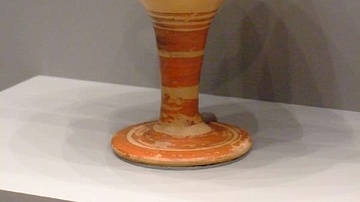
The Marine style, perhaps, produced the most distinctive of all Minoan pottery with detailed, naturalistic depictions of octopuses, argonauts, starfish, triton shells, sponges, coral, rocks and seaweed. Further, the Minoans took full advantage of the fluidity of these sea creatures to fill and surround the curved surfaces of their pottery in a truly unique artistic style which effortlessly conveys the obvious love these island people had for the sea.

Articles & Definitions

Minoan Pottery
Article

Minoan Pottery

The ever evolving pottery from the Minoan civilization of Bronze Age Crete (2000-1500 BCE) demonstrates, perhaps better than any...
Mycenaean Pottery
Article

Mycenaean Pottery

The pottery of the Mycenaean civilization (1550-1050 BCE), although heavily influenced by the earlier Minoans based on Crete...
Ancient Greek Pottery
Definition

Ancient Greek Pottery

Greek pottery has four main types: Geometric, Corinthian, Athenian Black-figure, and Athenian red-figure pottery. Pottery...
Etruscan Pottery
Definition

Etruscan Pottery

Etruscan pottery, produced over five centuries, was nothing if not varied. Indigenous wares such as the glossy black bucchero...
Korean Pottery
Definition

Korean Pottery

The pottery of ancient Korea stretches back to prehistory when simple brown wares were made and decorated with geometrical incisions...
Nazca Pottery
Article

Nazca Pottery

The pottery of the Nazca civilization, which flourished in ancient Peru between 200 BCE and 600 CE, is amongst the most distinctive...
Jomon Pottery
Definition

Jomon Pottery

The Jomon Period (c. 14,500 - c. 300 BCE) of ancient Japan produced a distinctive pottery which distinguishes it from the earlier...
Black Figure Pottery
Definition

Black Figure Pottery

Black figure pottery is a type of Greek pottery named after the colour of the scenes painted on vessels. It was first produced...
Red-Figure Pottery
Definition

Red-Figure Pottery

Red-figure Pottery is a style of Greek vase painting invented in Athens c. 530 BCE. The style has drawn red figures and a painted...
Bucchero
Definition

Bucchero

Bucchero wares are a shiny dark grey to black pottery produced by the Etruscans of central Italy from the 7th to 4th century BCE. Used...
Korean Celadon Pottery
Article

Korean Celadon Pottery

The celadon (or greenware) ceramics produced in ancient Korea during the Goryeo Dynasty (918-1392 CE), are regarded as some...
Ming Porcelain
Definition

Ming Porcelain

The porcelain of the Ming Dynasty of China (1368-1644 CE) benefitted, as did other arts, from the economic success of the 15th...

Illustrations

3D Models

Subscribe to this author

About the Author

Free for the World, Supported by You

World History Encyclopedia is a non-profit organization. Please support free history education for millions of learners worldwide for only $5 per month by becoming a member. Thank you!

World History Encyclopedia is a non-profit organization. Please support free history education for millions of learners worldwide for only $5 per month by becoming a member. Thank you!

Become a Member  

Support Us Remove Ads