Server Costs Fundraiser 2026
It costs $20,000 a year to run our servers, and we need your help to pay for them!
$5077 / $20000
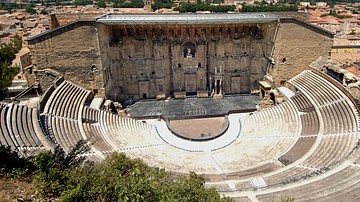
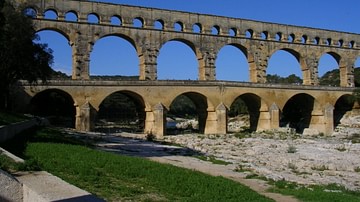
Roman architecture was nothing if not eclectic. From ingenious underfloor heating to gravity-defying arches, the Romans added to the Classical repertoire such grandiose structures as the triumphal arch, basilica, amphitheatre, and city tower block. The combination of brick, arch, and concrete allowed greater distances to be spanned than ever before so that interiors became bigger and ceilings higher. The Roman world encompassed countless peoples and cultures, but architecture helped stamp both Roman authority and culture on major cities from Cadiz to Constantinople. Still today, many of the finest ancient monuments seen across Europe, Asia, and North Africa are the works of Roman architects which have stood the test of time, warfare, and earthquake.
In this collection, we examine the particular and unique features of Roman architecture in general, look at some of the quintessential structures such as Roman baths and fortification walls, and study in depth a selection of outstanding Roman buildings such as the Colosseum and Pantheon.
Bedrooms and libraries should face east since their function requires morning light, and again, so that the books in libraries will not rot. (Vitruvius, On Architecture, Bk. 6, Ch. 4.1)
Questions & Answers
What type of architecture was Rome known for?
- The type of architecture Rome was known for includes the use of brick, marble, and concrete and the use of arches and domes to create amphitheatres, basilicas, triumphal arches, and apartment blocks.
What were the main features of ancient Roman architecture?
- The main features of ancient Roman architecture include well-built, attractive, and practically useful structures. Roman buildings were often as decorative inside as they were outside.
What are 3 examples of ancient Roman architecture?
- 3 examples of Roman architecture are the Colosseum in Rome, the Pantheon in Rome, and the Pont du Gard aqueduct in southern France.
Subscribe to this author
About the Author
Mark is WHE’s Publishing Director and has an MA in Political Philosophy (University of York). He is a full-time researcher, writer, historian and editor. Special interests include art, architecture and discovering the ideas that all civilizations share.
Free for the World, Supported by You
World History Encyclopedia is a non-profit organization. Please support free history education for millions of learners worldwide for only $5 per month by becoming a member. Thank you!
Become a Member
Donate
License & Copyright
Uploaded by Mark Cartwright, published on 16 May 2019. The copyright holder has published this content under the following license: Creative Commons Attribution-NonCommercial-ShareAlike. This license lets others remix, tweak, and build upon this content non-commercially, as long as they credit the author and license their new creations under the identical terms. When republishing on the web a hyperlink back to the original content source URL must be included. Please note that content linked from this page may have different licensing terms.
For commercial licensing enquiries, please contact our licensing agency Wright's Media.