The Architecture of Ancient Rome

Celebrate Our Anniversary with Trivia!

Join us on August 23 for a free virtual trivia party featuring questions about ancient civilizations, U.S. history, unusual historical facts, pop culture, and more.

$561 / $5000
Mark Cartwright
by
published on
bookmark_addbookmark_addedSave Collection

Roman architecture was nothing if not eclectic. From ingenious underfloor heating to gravity-defying arches, the Romans added to the Classical repertoire such grandiose structures as the triumphal arch, basilica, amphitheatre, and city tower block. The combination of brick, arch, and concrete allowed greater distances to be spanned than ever before so that interiors became bigger and ceilings higher. The Roman world encompassed countless peoples and cultures, but architecture helped stamp both Roman authority and culture on major cities from Cadiz to Constantinople. Still today, many of the finest ancient monuments seen across Europe, Asia, and North Africa are the works of Roman architects which have stood the test of time, warfare, and earthquake.

In this collection, we examine the particular and unique features of Roman architecture in general, look at some of the quintessential structures such as Roman baths and fortification walls, and study in depth a selection of outstanding Roman buildings such as the Colosseum and Pantheon.

Bedrooms and libraries should face east since their function requires morning light, and again, so that the books in libraries will not rot. (Vitruvius, On Architecture, Bk. 6, Ch. 4.1)

Articles & Definitions

Roman Architecture
Definition

Roman Architecture

Roman architecture continued the legacy left by Greek architects and the established architectural orders, especially the Corinthian...
Triumphal Arch
Definition

Triumphal Arch - A Roman Exercise in Architectural Vanity

The triumphal arch was a type of Roman architectural monument built all over the empire to commemorate...
Roman Walls
Article

Roman Walls

The many Roman walls still visible today throughout Europe and the Mediterranean, be they defensive walls such as the Servian Wall...
Roman Baths
Definition

Roman Baths

Roman baths were designed for bathing and relaxing and were a common feature of cities throughout the Roman empire. Baths included...
Pantheon
Definition

Pantheon - Rome's Best-Surviving Building

The Pantheon (Latin: pantheum) is the best-preserved building from ancient Rome and was completed in c. 125...
Circus Maximus
Definition

Circus Maximus

The Circus Maximus was a chariot racetrack in Rome constructed in the 6th century BCE. Used for other events such as the Roman...
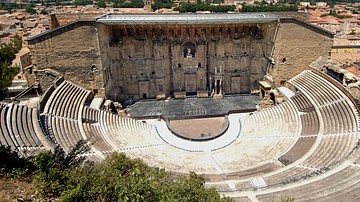
The Roman Theatre of Orange
Article

The Roman Theatre of Orange

The Roman theatre of ancient Arausio (modern day Orange in southern France) is one of the best-preserved examples from...
Hadrian's Wall
Definition

Hadrian's Wall

Hadrian's Wall (known in antiquity as the Vallum Hadriani or the Vallum Aelian) is a defensive frontier work in northern Britain...
Amphitheatre
Definition

Amphitheatre - The Roman Contribution to Public Architecture

An amphitheatre was a structure built throughout the Roman empire where ordinary people could...
Colosseum
Definition

Colosseum - Rome's Great Flavian Amphitheatre

The Colosseum or Flavian Amphitheatre is a large ellipsoid arena built in the first century CE by the Flavian...
Aqueduct
Definition

Aqueduct

Aqueducts transport water from one place to another, achieving a regular and controlled supply to a place that would not otherwise receive...
The Roman Domus
Article

The Roman Domus

The Roman domus was much more than a place of dwelling for a Roman familia. It also served as a place of business and a religious...

Illustrations

3D Models

Questions & Answers

What type of architecture was Rome known for?

The type of architecture Rome was known for includes the use of brick, marble, and concrete and the use of arches and domes to create amphitheatres, basilicas, triumphal arches, and apartment blocks.

What were the main features of ancient Roman architecture?

The main features of ancient Roman architecture include well-built, attractive, and practically useful structures. Roman buildings were often as decorative inside as they were outside.

What are 3 examples of ancient Roman architecture?

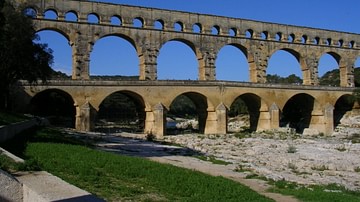
3 examples of Roman architecture are the Colosseum in Rome, the Pantheon in Rome, and the Pont du Gard aqueduct in southern France.
Subscribe to this author

About the Author

Free for the World, Supported by You

World History Encyclopedia is a non-profit organization. Please support free history education for millions of learners worldwide for only $5 per month by becoming a member. Thank you!

World History Encyclopedia is a non-profit organization. Please support free history education for millions of learners worldwide for only $5 per month by becoming a member. Thank you!

Become a Member  

Support Us Remove Ads