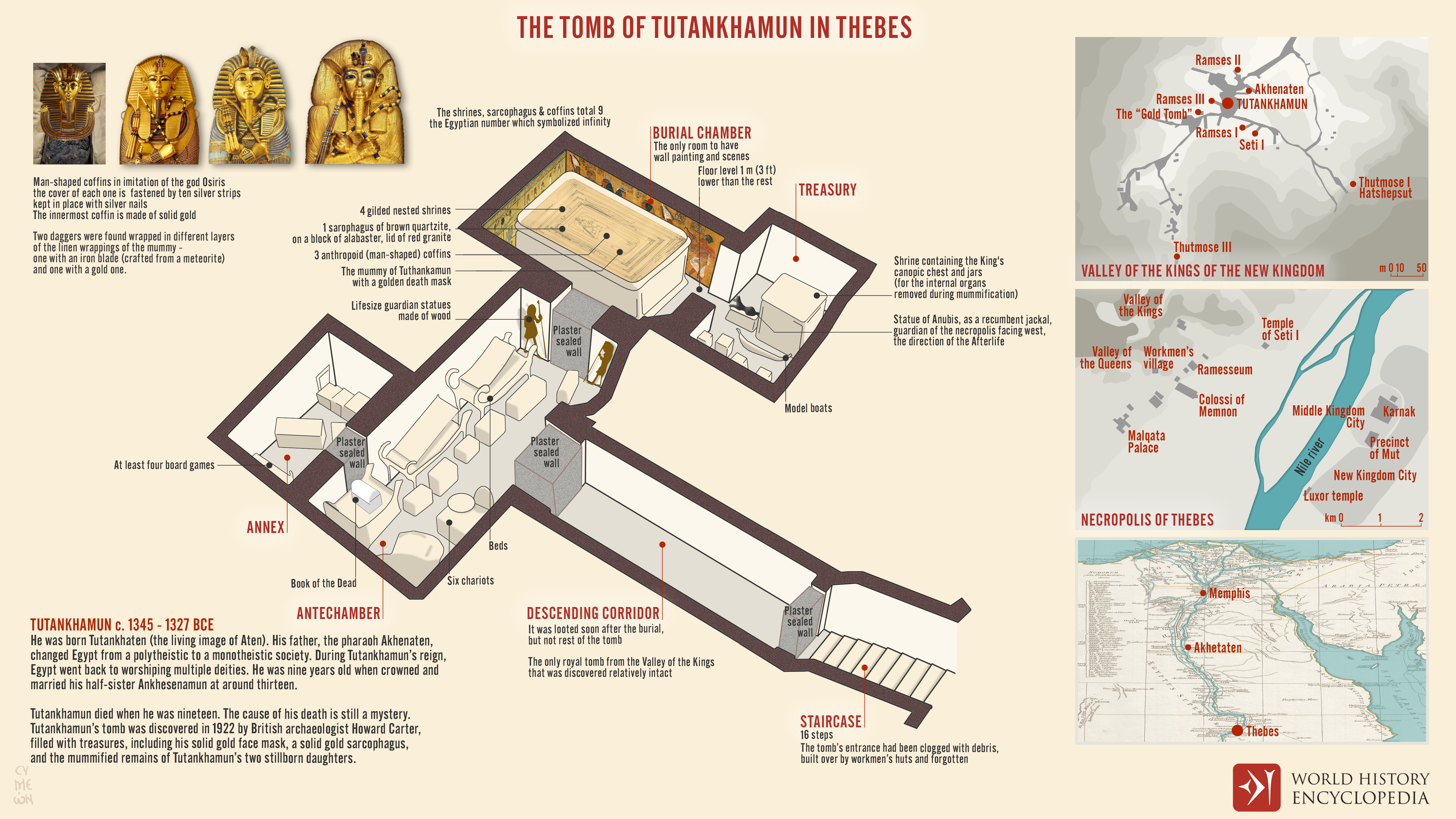
The Tomb of Tutankhamun (KV62), Thebes, c. 1323 BCE


The tomb of Tutankhamun (c. 1345–1323 BCE; reign c. 1332–1323 BCE), located in the Valley of the Kings, offers a rare and largely intact snapshot of royal burial practice during Egypt’s New Kingdom (c. 1550–1070 BCE). Although Tutankhamun’s reign fell within the late 18th Dynasty and followed the religious upheavals of the Amarna period, his relatively modest political role contrasts sharply with the global impact of his tomb’s discovery. The layout, comprising an antechamber, annex, burial chamber, and treasury, reflects both continuity in royal funerary tradition and the constraints of a hastily prepared burial, likely due to his unexpected death.
Tutankhamun ascended the throne as a child (c. 1332 BCE) and ruled for approximately a decade, restoring traditional religious practices after the reforms of his father, Akhenaten, (reign c. 1353–1336 BCE). His cause of death remains debated, with medical analyses suggesting a combination of illness, genetic vulnerability, and possible injury rather than assassination. The tomb (KV62), discovered in 1922 by British archaeologist Howard Carter, contained over 5,000 artifacts, including the iconic gold funerary mask. Its extraordinary preservation has provided unparalleled evidence for New Kingdom craftsmanship, royal ideology, and mortuary ritual, reshaping modern understanding of ancient Egyptian kingship and burial culture.
Questions & Answers
When did Tutankhamun rule Egypt?
- Tutankhamun ruled Egypt between c. 1336 and c. 1327 BCE.
What did Tutankhamun do during his reign?
- Tutankhamun began the process of dismantling his father's monotheistic belief system and returning Egypt to the polytheistic practices of the past. He died before he could finish this work, and it was accomplished by Horemheb, who then erased Tutankhamun's name and claimed the credit for himself.
Why is Tutankhamun so famous?
- Tutankhamun is famous because of the discovery of his nearly intact tomb in 1922, which was world news, and because of the "curse of the mummy" that became popularized in 1923 and was associated with the opening of the tomb.
Is there any basis in fact for the "curse of Tutankhamun"?
- No. The "curse of Tutankhamun" was based on a misinterpretation of an inscription found in the tomb and then the death of Howard Carter's patron, Lord Carnarvon in 1923. Carter knew there was no curse but allowed the story to circulate because it scared people away from the tomb so he could work in peace and also caused those who had illegally taken or purchased ancient Egyptian artifacts to return them, hoping to distance themselves from the "curse".