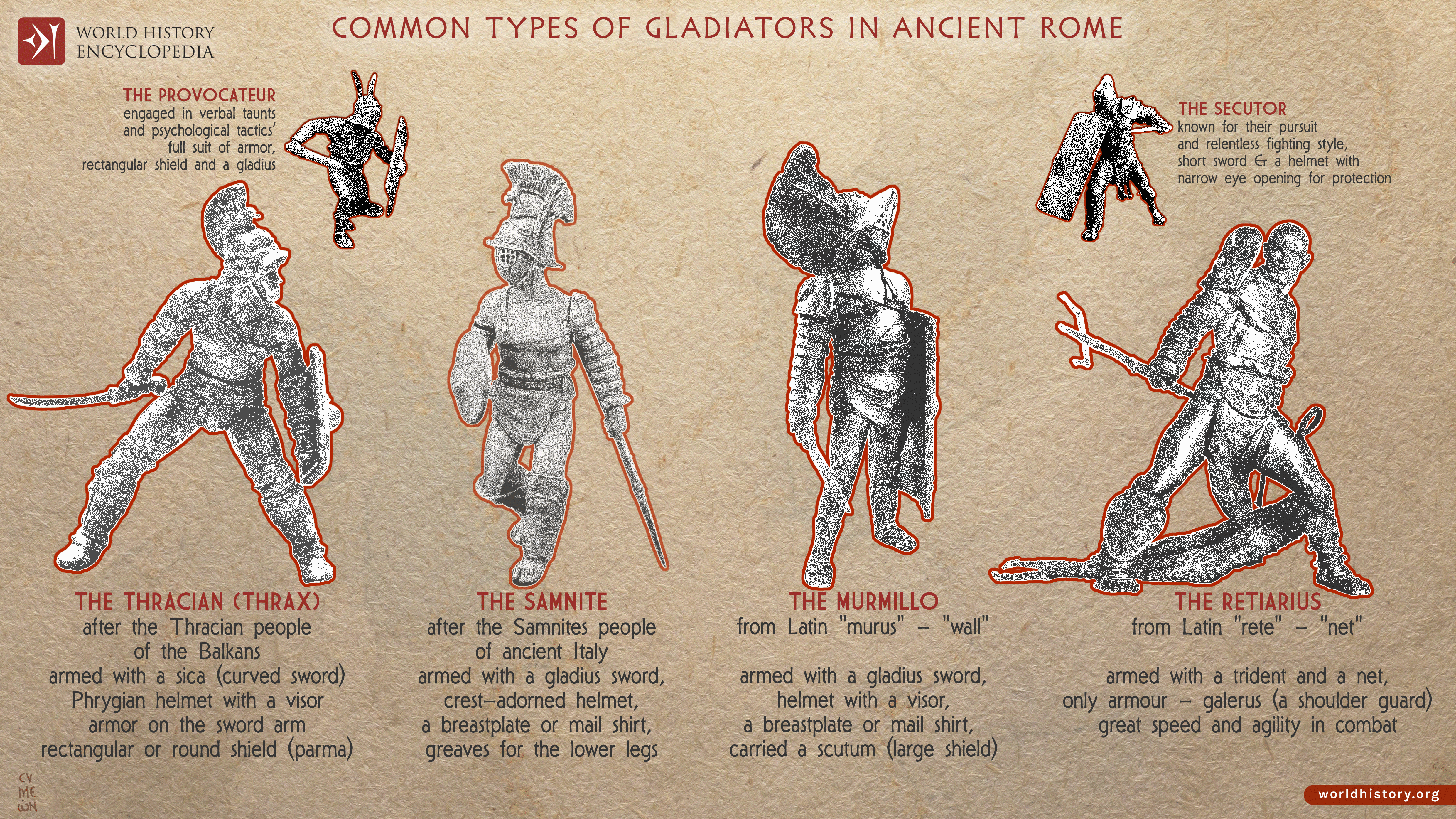
Common Types of Gladiators in Ancient Rome


This illustration depicts the main types of gladiators in ancient Rome, professional fighters who became central to the bloody spectacles of the amphitheater. Drawn from diverse backgrounds: slaves, prisoners of war, criminals, and even freeborn volunteers seeking fame or fortune, gladiators trained in specialized schools to master weapons, tactics, and endurance. They were classified into distinctive types such as the Thraex, Murmillo, Samnite, Retiarius, among others, each with equipment and fighting styles inspired by Rome’s conquered peoples and adapted to create dramatic contrasts in the arena.
The gladiatorial system was as much about performance as combat. Carefully staged matches pitted heavily armed warriors against lightly equipped, agile opponents to heighten suspense and showcase Roman ideals of discipline, valor, and martial skill. The games also served political and social purposes: emperors and magistrates sponsored spectacles to win public favor, reinforce hierarchy, and demonstrate Rome’s dominance over life and death. For the crowds, gladiators embodied both fear and fascination, their struggles reflecting the harsh realities of Roman society while providing one of antiquity’s most enduring forms of entertainment.
Questions & Answers
Where did the gladiators fight?
- Gladiators fought in oval-shaped amphitheatres, specially designed for gladiatorial combats. The most famous amphitheatre was the Colosseum (or Flavian Amphitheatre), built in the 1st century CE in Rome. The massive arena could hold about 50,000 spectators. However, until the 1st century CE, gladiators fought in the Forum Romanum, the Circus Maximus, and other arenas with stands made of wood.
What was the venatio?
- The venatio was a form of gladiator entertainment in Roman amphitheatres, which included the hunting and slaying of wild animals, such as lions, bears, elephants, leopards, tigers, boars, and many others. The lion was extremely popular in venationes. Julius Caesar (l. 100-44 BCE) is said to have celebrated the consecration of his forum in Rome with the slaughter of 400 lions in one venatio.
Were there female gladiators?
- Historians believe that women also fought as gladiators until it was outlawed in the 3rd century CE. The Roman historians Cassius Dio (l. 155-235 CE) and Suetonius (l. 69-130 CE) mention female gladiators in their writings. Archaeological evidence includes a marble relief found at Halicarnassus (now in the British Museum), which depicts two female gladiators facing each other and holding swords and shields.