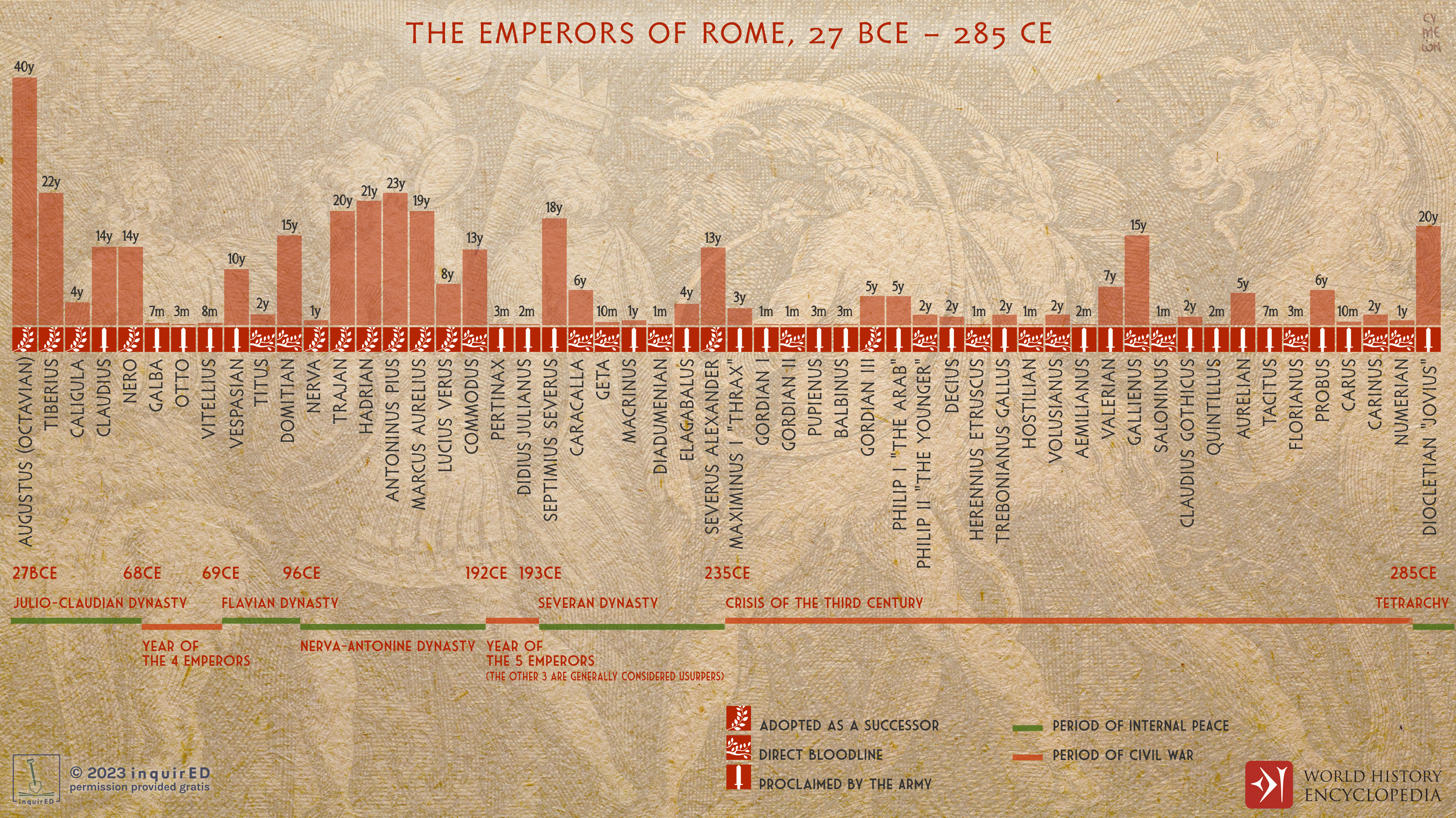
The Emperors of Rome, 27 BCE - 285 CE

This infographic presents the timeline of Roman emperors from Augustus to Diocletian, covering nearly three centuries of imperial rule. It traces the transformation of Rome from republic to empire, through stability, crisis, and reform, ending with the creation of the Tetrarchy in 285 CE, the first formal division of imperial power.
The sequence begins with Augustus (reign 27 BCE–14 CE), whose rule inaugurated the Pax Romana, an era of prosperity and expansion. His successors included Tiberius (reign 14–37 CE), the troubled Julio-Claudian dynasty, and the Flavian dynasty, who restored stability after the chaos of 69 CE, the “Year of the Four Emperors.” Later rulers such as Trajan (reign 98–117 CE) oversaw Rome at its greatest territorial extent, and Marcus Aurelius (reign 161–180 CE) exemplified the philosopher-king ideal. After the Severan dynasty (193–235 CE), Rome entered the Crisis of the Third Century (235–284 CE), marked by rapid succession, usurpations, civil war, and external invasions. Stability was restored under Diocletian (reign 284–305 CE), who reorganized the empire’s administration and in 285 CE established the Tetrarchy, dividing rule among four emperors and laying the foundation for the empire’s late-antique transformation.
License & Copyright
 Copyright © inquirED, permission provided gratis. Published under a Creative Commons Attribution-NonCommercial-ShareAlike 4.0 International Public License. Uploaded by Simeon Netchev, published on 04 September 2023. The copyright holder has published this content under the following license: Creative Commons Attribution-NonCommercial-ShareAlike. This license lets others remix, tweak, and build upon this content non-commercially, as long as they credit the author and license their new creations under the identical terms. When republishing on the web a hyperlink back to the original content source URL must be included. Please note that content linked from this page may have different licensing terms.