
Search
Remove Ads
Advertisement

 This answer was generated by
 Search Results
Image
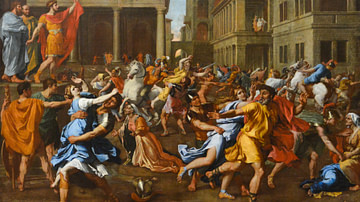
The Rape of the Sabine Women
The Rape of the Sabine Women, painting by Nicolas Poussin, 1637-1638 CE.
Louvre, Paris
Photo credit: Francisco Anzola

Article
Women in the Russian Revolution
Women actively participated in the Russian Revolution of 1905 and the two revolutions of 1917, which deposed the tsar and established a Bolshevik government. Women worked both within the Bolsheviks led by Vladimir Lenin (1870-1924) and in...

Article
Women in World War I - Changing Roles & Rights
During the First World War (1914-18), as governments sought to field the largest armies possible and so conscripted millions of men to the fighting fronts, the role of women in society was greatly expanded. Women worked as nurses and medical...

Image
The Intervention of the Sabine Women
Painting by Jacques-Louis David (1748–1825), oil on canvas, 1799. On display at the Louvre Museum, Paris, France. The Abduction (or Rape) of the Sabine Women is an episode in the legendary history of Rome, traditionally said to have taken...

Article
Women in the Middle Ages
The lives of women in the Middle Ages were determined by the Church and the aristocracy. The medieval Church provided the 'big picture' of the meaning of life and one's place while the aristocracy ensured that everyone stayed in their respective...

Article
Women in the American Revolution
In Colonial America, women were discouraged from taking an interest in politics and were instead expected to focus only on traditionally 'feminine' matters, such as homemaking and childrearing. However, such gender roles were challenged during...
Article
The Role of Women in the Roman World
The exact role and status of women in the Roman world, and indeed in most ancient societies, has often been obscured by the biases of both ancient male writers and 19-20th century CE male scholars, a situation only relatively recently redressed...

Article
Women in Ancient Persia
Women in ancient Persia were not only highly respected but, in many cases, considered the equals of males. Women could own land, conduct business, received equal pay, could travel freely on their own, and in the case of royal women, hold...

Article
Women in Ancient Mesopotamia - Celebrating the Feminine Principle in the Near East
The lives of women in ancient Mesopotamia cannot be characterized as easily as with other civilizations, owing to the different cultures over time. Generally speaking, though, Mesopotamian women had significant rights, could own businesses...

Article
Spartan Women
Spartan women had more rights and enjoyed greater autonomy than women in any other Greek city-state of the Classical Period (5th-4th centuries BCE). Women could inherit property, own land, make business transactions, and were better educated...
